
Azzaro
Pour Homme
An aromatic fougère from 1978, Azzaro pour Homme opens on a lavender and anise accord of sharp clarity, pulled toward the herbaceous by basil and clary sage. Cardamom and caraway spice this opening; patchouli, sandalwood and vetiver lead to a base of oakmoss, leather and tonka bean. Luca Turin holds it to be the most accomplished of the aromatics. It stayed twenty-five years at the top of French sales.
- Brand
- Azzaro
- Launch year
- 1978
- Perfumer
- Gender
- Men
- Olfactory family
- Fougère
- Secondary family
- Aromatic
- Concentration
- Eau de Toilette
Iconic perfume
Where to buy
A fragrance its creator did not want
Loris Azzaro dressed women. In 1975, a feminine fragrance produced in a run of two hundred fifty bottles by a laboratory in Grasse met with unexpected success; the German group Mäurer & Wirtz took over manufacturing and proposed a masculine version to the designer.
The designer did not want it. He would later say that if he had been listened to, no men's fragrance would ever have come out of his house. He agreed on two conditions: a parfum rather than an eau de cologne, and an amber juice.
The formula appeared in 1978 behind a line the advertising would keep: a fragrance for men who love women who love men. Luca Turin notes that it was not written for slow minds.
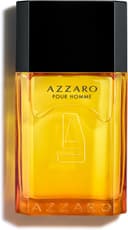
An amber bottle like bourbon, signed Pierre Dinand
The tint was not a designer's whim. Loris Azzaro demanded it when he agreed to the project, and he wanted it close to bourbon. The color of the juice was thus fixed before the glass was designed, which rarely happens.
Pierre Dinand signed the bottle. Smoked amber glass, modernist typography, faceted architecture: the aesthetic codes of 1978, held without excess. The resemblance to a glass of bourbon comes from there, and from the designer's request.
Dinand's name is missing from most French sources, which describe the bottle without crediting him. It does appear, however, in the press article from which all these accounts derive, published in August 2012 under the byline of Catherine Deydier.
A paternity claimed by six perfumers
The composition was entrusted to Firmenich. The name that comes up everywhere is that of Gérard Anthony, also credited with Balenciaga pour Homme in 1990. English-language databases cite him without exception.
The second name varies by source. French sources, all drawn from the same press article, write Martin Heiddenreich. English-language databases write Richard Wirtz, the surname of the German group that had commissioned the project.
Luca Turin leaves the question open and says why: he reports having met six perfumers who each claim authorship of this formula. Gérard Anthony's name is therefore listed alone in the database, with the other two cited without arbitration.
Twenty-five years at the top, and a named lineage
The fragrance sold for twenty-five years at the top of the French and international market, despite coming from a feminine fashion house and targeting an openly macho audience. Gérard Delcour, who ran Azzaro's perfumes between 1985 and 1990, believed it should not be touched.
Its lineage is named: L'Homme by Roger & Gallet in 1980, Drakkar Noir in 1982, Boss in 1986, Polo Sport in 1994, Rive Gauche pour Homme in 2003, Ice Men in 2007. Six fougères built on the same frame.
The campaigns sought faces rather than ideas: Enrique Iglesias in 2009, Ian Somerhalder in 2014. These choices belong to their decade and say nothing of how the fragrance smells today.
Olfactory pyramid
- Top notesThe first minutes
- Heart notesThe heart of the perfume
- Base notesWhat lingers
What the community says
Season
Occasion
The community finds it similar to…
- Paco — Paco Rabanne1 vote
Create an account to keep your votes and find your notebook.