
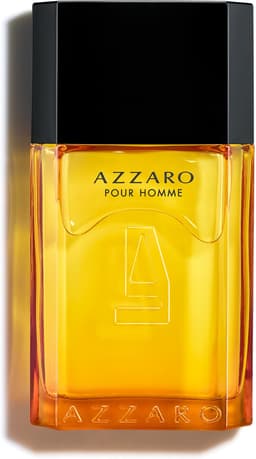
An aromatic fougère from 1978, Azzaro pour Homme opens on a lavender and anise accord of sharp clarity, pulled toward the herbaceous by basil and clary sage. Cardamom and caraway spice this opening; patchouli, sandalwood and vetiver lead to a base of oakmoss, leather and tonka bean. Luca Turin holds it to be the most accomplished of the aromatics. It stayed twenty-five years at the top of French sales.
The signed review places it at the summit of aromatic fougères: Luca Turin gives it five stars and reduces it to two words, anisic lavender. Wearers describe a powerful barbershop scent, to be dosed carefully, and judge older bottles to be foamier.
Olfastory’s review
What the signed review says
Luca Turin and Tania Sanchez give it five stars and hold it to be the most successful of aromatic fougères. Turin reports having put it on again after twenty years without wearing it, and finding it exactly as he had left it.
His description fits in two words, anisic lavender. He underscores its affable and slightly vulgar character, with no pretension whatsoever, which in his vocabulary counts as praise, not reservation.
Collectors' accounts concerning bottles from the first decade describe a massive opening of anise and lavender, heightened by clary sage, with a dry, sharp bitterness that never tips into unpleasantness.
The vocabulary of wearers
One word dominates the reviews, and that word is barbershop. Shaving cream, soap, licorice-like anise: the vocabulary is that of old-fashioned men's grooming, and it is used as praise, never as a criticism.
Comparisons are constant with Drakkar Noir and with Rive Gauche pour Homme, which several wearers say descend from this same frame. The lineage is documented elsewhere than in reviews, which makes it more solid.
The most frequent reservation concerns dosage. The sillage is considered massive, and several wearers recommend two sprays rather than four, otherwise the bitterness of the opening becomes overwhelming.
Old bottles versus recent bottles
Those who have worn it since the beginning describe older versions as foamier, deeper, with a more tenacious base. Some say they have worn the fragrance since 1978 and have observed these shifts very closely.
Current versions are considered clearer and lighter. Some wearers see this as a loss; others feel the reduced strength makes the fragrance more wearable today than it once was.
These comparisons rest on memories and on bottles whose preservation varies. They align closely enough to be worth reporting, but not closely enough to settle the matter: no published comparative analysis supports them.
Who it suits
It suits above all those who love anise, a divisive raw material that occupies the entire foreground here and never fully disappears. Those who avoid it will have no reason to get past the first ten minutes.
It will disappoint those seeking something modern, transparent and discreet. The fragrance follows the opposite logic: presence, contrast, an unapologetic bitterness and a base that holds for several hours without weakening.
Fall and winter suit it better than intense heat, where its density becomes heavy. Evenings and formal settings suit it well; several wearers also describe it as an office fragrance, provided the dose is right.