
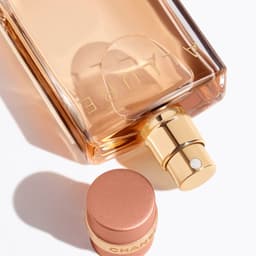
Allure femme, a natural seduction More than a luxury brand, Chanel embodies a state of mind. Gabrielle Chanel brought a wind of modernity and grace to the world of fashion. The refinement and elegance of Chanel collections are known throughout the world. The house of Chanel's first fragrance was created in 1921, Chanel N 5.
Released in 1996, “Allure” is the olfactory representation of elegance as defined by Gabrielle Chanel. Indeed, Mademoiselle always had a very precise idea of allure. According to her, allure is an elegant, natural silhouette, above all free of artifice. While allure is something entirely undefinable, it is no less irresistible for that. “Allure” was therefore to be an ultra-elegant, seductive essence, yet entirely natural. Because there are as many women as there are types of allure, Jacques Polge built his composition around six facets.
Allure, a great success by perfumer Jacques Polge
In 1996, it was Jacques Polge, the in-house perfumer of Chanel, who created “Allure”. He had succeeded Henri Robert in 1978. Ever discreet, Jacques Polge states that he does not know how to talk about his craft. His first creation, and by no means a minor one, was “Coco”, a worldwide success. Jacques Polge faced the difficult task of upholding the spirit and tradition of the house of Chanel while bringing it a fresh wind of modernity. His first fragrance, “Coco”, was a true tribute to the great “Mademoiselle”, who was also known as “Coco”. With this tribute, Jacques Polge rose to the top of Chanel's creative team and remained there for a very long time, retiring in 2012. He was succeeded by his son, Olivier Polge… One might believe that in the Polge family, talent is passed down through the genes. We owe to Jacques Polge such magnificent fragrances as “Egoïste”, “Bleu de Chanel” and “N°19 Poudré”.
The 6 facets of Allure by CHANEL
Jacques Polge wished to create “Allure” in 6 facets, each yielding a distinct result from one woman to another… This is why “Allure” does not follow the natural progression from top notes to base notes. The first facet of “Allure” is intended to be fresh and biting, essentially thanks to the citrus note of Calabrian lemon. The second facet is fruity, particularly through Sicilian mandarin. The third facet is floral and features jasmine. The fourth facet is also floral, but with a green aspect, as it contains water lily, honeysuckle and magnolia. Water lily is an aquatic plant that grows on the water's surface. Although little used in perfumery, water lily gives off a floral scent that is both sweet and sensual, with vegetal undertones. Honeysuckle is used in many feminine compositions. It offers sweet facets with jasmine-like, orange-like, but also vegetal and honeyed accents. The fifth facet is woody, mainly thanks to vetiver from Haiti. Vetiver has been known and used since antiquity. In perfumery, vetiver is a quintessentially masculine ingredient, as it lends a strong dose of virility. Vetiver from Haiti offers woodier facets than traditional vetiver, even slightly smoky ones. Finally, the last facet is oriental, revealing Bourbon vanilla in particular. It should be noted that Jacques Polge's composition is not only elegant but genuinely well balanced.