
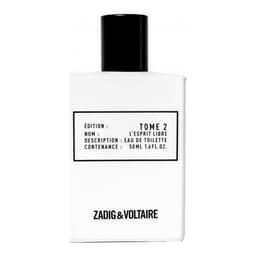
The perfume Tome 2 Zadig Voltaire L'Esprit Libre In this year 2017, Zadig Voltaire decided to set aside its very rebellious side in favor of a more restrained style steeped in the world of reading. Thus, the chic and avant-garde house offers this time an assemblage of three fragrances conceived as three large volumes to collect.
Released in 2017, Tome 2, l'Esprit Libre follows Tome 1, la Pureté. It is also followed by Tome 3, L'Être. A unisex fragrance, the different tomes refer to reading, dear to the heart of Thierry Gillier, the creator of the brand. It should not be forgotten that the name of the house Zadig et Voltaire comes from this love of literature, Zadig ou la destinée being a novel by Voltaire. At once floral and green, the composition of Tome 2, l'Esprit Libre is entirely androgynous.
Tome 2, l'Esprit Libre, for the freedom of literature
If Tome 1 had purity as its theme, Tome 2 is a free spirit, but a literary spirit. If the brand's founder had a great passion for literature, he particularly loved the works of Voltaire. Airy and tempting, Tome 2, l'Esprit Libre is a composition that conceals its game well. Gourmand to the utmost, it also displays a freshness that is both floral and green. All of Zadig et Voltaire's tomes were designed to be androgynous perfumes. As much for women as for men, the scent of Tome 2 is a scent for free spirits.
Tome 2, l'Esprit Libre, delightfully powdery notes
Tome 2, l'Esprit Libre takes flight on the juicy freshness of pear. Originating from northern Central Asia, the pear tree grew wild in prehistoric times. Today, the main producers of pear are China, Italy, the United States and Russia. The flesh of the pear is fine and sweet, and pear is enjoyed from August to September. Besides cooking, pear is used in the making of drinks and eau-de-vie. In perfumery, the pear note is reproduced synthetically in a laboratory. Pear gives off sweet, fruity and soft tonalities. Then, the heart of Tome 2, l'Esprit Libre develops toward powdery and green notes, thanks to the presence of iris and green notes. Along with oud, iris is the most expensive ingredient in perfumery. The history of iris begins well before the Christian era. The Greeks had the privilege of putting the sky in communication with the earth, and iris then borrowed the colors of the rainbow. The treatment of rhizomes used in perfumery is very delicate, and its extraction process is long, which explains its price. Called the blue gold of perfumery, iris is grown in Grasse, just like rose and jasmine. Iris is a majestic flower highly prized in perfumery. It gives off notes that are both green and powdery. Finally, the base offers a sillage composed of a breath of ambrette, which gives the whole composition a musky, almost animalic scent. The bottle is as if inspired by a book. With a minimalist design, the bottle is entirely lacquered white with a label written in black, evoking the cover of a book.