
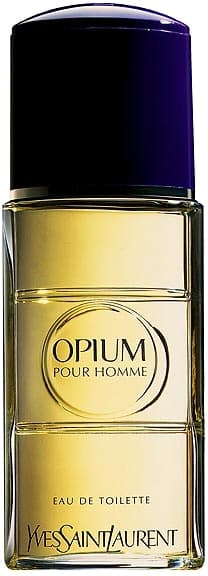
The fragrance Opium pour Homme, revisiting the myth, in a masculine version. It was in 1961 that Yves Saint Laurent founded the fashion house bearing his name. Very quickly, a reinvented, provocative style emerged, one that upended the established codes of the time.
Released in 1995, Opium pour Homme followed the immense success of Opium, launched in 1977. A true legend of perfumery, Opium made headlines upon its release, as its name symbolized debauchery and lust. Yet with its power and sensuality, Opium nonetheless achieved a triumph. With Opium pour Homme, YSL opens up the mystery of seduction in its masculine form. Enigmatic, yet as powerful as its feminine counterpart, Opium pour Homme seduces, surprises, and dazzles. A touch of magic signed Jacques Cavallier.
Jacques Cavallier composes YSL's Opium Homme with masculine seduction in mind
Born in 1962 in Grasse, Jacques Cavallier-Belletrud grew up surrounded by flower fields. His father and grandfather were also perfumers, having passed down a love of perfumery from generation to generation. From 1990 to 2012, Jacques Cavallier worked for the company Firmenich. Since 2012, he has been the official perfumer for the house of Louis Vuitton. Regarding this role, he explains that the adventure is unique and particularly exciting, all the more so since the house's values are his own: respect for craftsmanship, artisanship and the choice of the noblest raw materials. Jacques Cavallier is behind such magnificent fragrances as Ultraviolet by Paco Rabanne, Nina by Nina Ricci, and Pi by Givenchy.
Opium pour Homme, mysterious oriental and fresh notes
Here, Jacques Cavallier chose to pair freshness with woody and oriental tones. Opium pour Homme opens with aromatic notes such as tarragon, lavender and star anise, combined with very fruity notes, namely mandarin and blackcurrant. The blackcurrant bush is a plant native to Europe. As early as the 16th century, blackcurrant was cultivated in France, mainly in the Loire Valley. It was then used for its many medicinal properties. Blackcurrant takes the form of black berries growing in clusters. In perfumery, blackcurrant gives off fruity, sweet, bitter and also green scents. Then, the heart of Opium pour Homme is built on Sichuan pepper, geranium, Chinese galangal and ginger, combining floral and spicy notes. Sichuan pepper was brought to Europe in the 13th century by Marco Polo.
Sichuan pepper, also called Chinese pepper, is an Asian spice. Its berries are harvested at the end of summer and dried in the sun until they turn reddish-brown. In perfumery, Sichuan pepper gives off fresh, spicy, dry and woody tones. As for Chinese galangal, it is rarely used in perfumery. Here, it lends its aphrodisiac properties, creating, together with Sichuan pepper, an incredible intensity. Finally, the base of Opium pour Homme is woody and mysterious, combining Atlas cedar, Bourbon vanilla, Haitian vetiver and amber, leaving an ultra-mysterious sillage. The Opium pour Homme bottle takes up the main codes of its feminine counterpart. Its shape recalls the Inro of Japanese warriors, a box they hung from their belts to hold alcohol or medicine.