
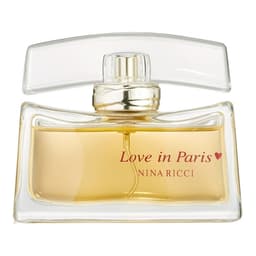
Love in Paris, a Parisian melody between dream and reality Founded in 1932 by Nina Ricci, the house of the same name has continued to evolve and imagine extraordinary creations. Its collections are elegant, glamorous, resembling the chic of the capital.
Released in 2004, Love In Paris is the representation of Nina Ricci’s love for the capital. Romantic and unique, the encounter with Love In Paris plunges us into romantic Paris, the cobblestones, the banks of the Seine, the Opéra, the Champs-Élysées, nighttime encounters. Here, the atmosphere is hushed, enigmatic and, of course, sensual. Love In Paris is not only a fragrance of love, but also an ode to happiness. Love In Paris is a floral melody, a melody of happiness that sweeps us into an irresistibly incredible whirlwind of life.
Love In Paris, the fragrant melody of happiness orchestrated by Aurélien Guichard
To compose the melody of happiness, Nina Ricci called on a great perfumer, Aurélien Guichard. One could say that for Aurélien Guichard’s family, the perfumery bug was passed down through the genes, since Aurélien Guichard represents the 7th generation of perfumers. His father, Jean Guichard, is not only an excellent perfumer but also the director of the Givaudan school. When asked what emotion he would like to put into a bottle, Aurélien Guichard states something very complicated and with no rules: desire. Desire in a bottle is something one is always searching for. One can rationalize formulas as much as one wants, but there is always a connection to beauty, but also to imperfection, that little thing one cannot control and which creates desire. Aurélien Guichard is regarded as a highly talented but also highly creative perfumer. He is behind magnificent successes such as For Her l’Absolu by Narciso Rodriguez, Madly Kenzo by Kenzo and This is Him! by Zadig & Voltaire.
The floral elegance of Love In Paris by Nina Ricci
Aurélien Guichard succeeded in imagining a romantic and sparkling accord built around rose and peony. Love In Paris opens with the fresh notes of Calabrian bergamot paired with the impertinence of star anise, all wrapped in the sweetness and voluptuousness of apricot. Also called Chinese badiane, star anise is the fruit of the star anise shrub. Native to China, star anise was brought to Europe by the English at the end of the 16th century. Star anise was then used for its medicinal properties. In the West, it is also used to flavor beverages. In perfumery, star anise is obtained by distilling the seeds of the shrub. Star anise releases aromatic, herbaceous and syrupy tonalities. Then, the heart of Love In Paris is ultra elegant and thoroughly feminine, combining rose, peony and jasmine. Native to the Far East, peony loses its foliage in winter to bloom again in spring. Peony takes its name from the Greek for healing plant, thanks to its many curative properties. For the Chinese, peony is the Queen of flowers. In perfumery, it offers floral, airy, rosy and delicate tonalities. Finally, the base of Love In Paris leaves an ultra sensual sillage thanks to the presence of vanilla and white musks.