
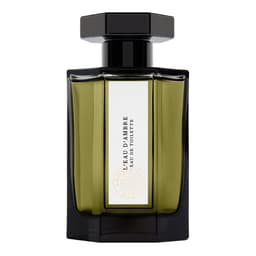
L’Eau d’Ambre opened the perfume line of L’Artisan Parfumeur in 1978, two years after the amber ball that made the house known. Four materials carry it, and the house names them all: benzoin, labdanum, patchouli and tonka bean. It sees in it an oriental perfume, and the tale of the Thousand and One Nights.
Four materials, all declared by the house, with no published tiering at all.
What the house declares
Benzoin, labdanum, patchouli and tonka bean. The house presents them as a synergy of the most precious materials in perfumery, and goes no further: no order, no tier, no proportion.
The amber accord dominates from the first moment to the last, without any sharp movement, and none of the declared materials takes the lead at the opening: all of them are written at the base.
What stays out
The market serves another list: amber, vanilla, patchouli and geranium. Patchouli alone figures in both. Geranium recurs among several reviewers, who set it at the opening, green and mineral; the house names it nowhere, and it stays in prose.
Vanilla is in the same position as geranium. Everyone hears it and nobody declares it, which often happens on an amber accord, where benzoin and tonka bean produce its effect without it entering the formula.
What the label declares
Twelve entries: denatured alcohol, water, fragrance, benzyl alcohol, and eight regulated allergens — linalool, coumarin, benzyl benzoate, citronellol, geraniol, limonene, cinnamal, citral. No substance banned in the European Union appears there. The list is the one the house publishes, and 24S serves the same, word for word.
The geraniol on that list attests nothing about geranium: it is an odorant constituent also carried by rose and citronella, declared because regulation requires it.