
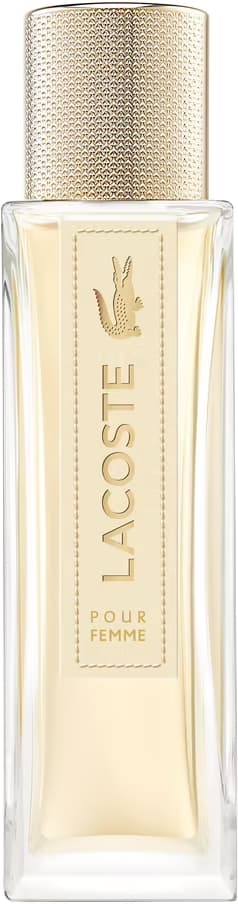
Pour Femme, an eau de parfum launched by Lacoste in 2003, is the feminine counterpart to Pour Homme, released a year earlier. Olivier Cresp built it as a woody floral: freesia and black pepper in the top, jasmine, rose and heliotrope in the heart, cedar and suede in the base. Its glass bottle, with a slender silhouette, comes in a beige, gold and white box.
The house describes Pour Femme in three tiers: freesia and black pepper in the top, a floral accord of jasmine, rose and white heliotrope in the heart, cedar and suede in the base. It places it in the woody floral family.
Freesia and black pepper
The opening pairs the floral freshness of freesia with the bite of black pepper. The house speaks of an explosion of these two materials, a bright flower lifted by a dry spice that opens the fragrance on a contrast.
Jasmine, rose and heliotrope
The heart, which the house wants light and feminine, reveals an accord of jasmine, rose and white heliotrope. Heliotrope, a flower with powdery, almond-like facets, gives the bouquet its softest nuance.
Cedar and suede
In the base, the house describes the warm caress of cedar and suede, which give the fragrance its structure and elegance. Suede brings a supple skin note, cedar a woody foundation.
The 2003 formula
At its launch, the house detailed its materials more fully: a peppery opening paired with purple freesia, a heart of Iranian jasmine, hibiscus flower and rose, and a base that brought together Himalayan cedar, sandalwood and an accord called “velvet skin.”
Similar perfumes
Similar notes and family, from other houses.
- La Nuit Trésor Dentelle De RosesLancôme
- Si PassioneArmani
- CoachCoach
- For Her Musc NoirNarciso Rodriguez
- Peony & Blush Suede CologneJo Malone
- BabycatYves Saint Laurent
- 24 Rue de L'UniversitéYves Saint Laurent
- Ma DameJean Paul Gaultier
More perfumes from Lacoste
Also composed by Olivier Cresp
- Dance with RepettoRepetto
- Anaïs Anaïs Premier DéliceCacharel
- Kenzo AmourKenzo
- Nina RoseNina Ricci