
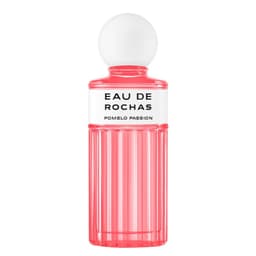
The fourth summer installment of Eau de Rochas, Pomelo Passion places grapefruit at the center of a floral musky citrus composition by Nathalie Gracia-Cetto. Bitter orange and passion fruit stretch out the opening, peony, rose and geranium round out the heart, and musks and amber close a sillage that stays close to the skin. The house brings back, without saying so, a raw material that its 1970 water already carried in its top notes.
The opening holds nothing back. Pomelo arrives full, zesty, with that bitterness that sets grapefruit apart from sweeter citrus fruits, and it occupies the foreground alone for the first few minutes.
Bitter orange accompanies it without contradicting it: same rind, same dryness, and above all the function of keeping the top from turning into fruit juice. Passion fruit plays against type. Exotic, naturally a bit sulfurous, it gives the whole a tart roundness that softens the attack without sweetening it. It is the only non-citrus fruit that the collection has featured since 2023.
The heart arrives quickly. Peony, rose and geranium form a pink bouquet, in both the literal and figurative sense: peony for the watery, petal-like facet, rose for longevity, geranium for its green, slightly minty bite, which bridges back to the bitterness of the top. It is a connecting heart rather than a showcase one; it does not seek to make one forget the citrus, but extends it by other means.
The base is short and low. Musks, which the house calls rosy, and an amber note lay down a warm veil that stays close to the skin. This stays within the register of an eau fraîche: nothing here seeks to build a long sillage.
One detail deserves a pause. The announced base does not simply say amber: it names Ambrofix, which is not a raw material but a patented Givaudan ingredient. Behind this name lies ambroxide, the molecule that has been used since the 1950s to recreate the smell of ambergris without resorting to the sperm whale. Givaudan now produces it by fermenting sugarcane, a process that has succeeded the extraction of sclareol from clary sage and that requires a hundred times less land. For a supplier's patented ingredient to be named in the marketing of a mass-market eau de toilette is rare; that the perfumer is precisely a perfumer employed by that supplier partly explains it.
The regulatory list says what the pyramid leaves out. It names three citrus oils, orange, bergamot and lemon, even though neither bergamot nor lemon appears among the announced notes: the top citrus accord is broader than the trio displayed. It also lists a rose oil and a geranium oil, which show that the heart does not rely solely on reconstitutions. Alpha-isomethyl ionone accounts for the slight powdery facet of the second phase. Two sun filters appear, common in clear waters intended for summer. No colorant, however: the pink is in the glass, not in the juice.
In wear, reviews converge on one point. For an eau fraîche, the longevity is a pleasant surprise: several wearers note it as better than expected from a citrus composition. This is consistent with a musky-ambery base tasked with fixing a citrus accord that is by nature volatile, the primary function of ambroxide in a formula of this kind.
It remains to place it within its own range. Against Citron Soleil, drier and more overtly acidic, and Néroli Azur, whose orange blossom established a sun-kissed sweetness, Pomelo Passion chooses the fruity route. It is the only one in the series whose heart is a bouquet of pink flowers, whereas the previous three drew theirs from neroli, jasmine or magnolia. Against the 1970 Eau de Rochas, the kinship is more one of principle than of form: the same way of treating freshness as structure, but without the oakmoss, vetiver and sandalwood base that gave the original its length.