
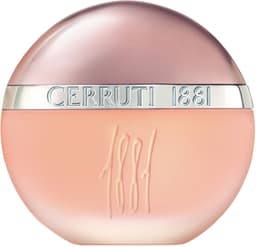
Claire Cain signed in 1995 the feminine counterpart of 1881, five years after the masculine. The whole fragrance revolves around a flax flower note that does not exist: the plant yields no extract, the note is reconstructed from scratch, and it ties the bottle to the house's fabrics. Around it, a very wide bouquet of mimosa, violet, freesia, jasmine, narcissus and tuberose, over a dry base of sandalwood and musks.
Claire Cain composed 1881 pour Femme in 1995, five years after the masculine by Martin Gras. The constraint is unusual: build an entire fragrance around a note with no model in nature, one that therefore has to be invented.
A bouquet wide by design
The opening starts on bergamot and coriander, quickly covered by flowers: mimosa, violet, freesia. Nothing green or sharp here, unlike the masculine, and the entry is powdery from the first minutes.
The heart stacks jasmine, lily of the valley, orange blossom, narcissus and tuberose, with Roman chamomile and geranium to cut the sweetness. Such a pile-up should blur into confusion; it holds because no single flower dominates the others.
It is the opposite bet from the masculine. Where 1881 Homme keeps a bouquet standing by leaving it bare, the feminine deliberately floods it, until it yields an impression of flower in general rather than one recognizable flower.
The flax flower, a note without a model
Flax blooms pale blue and gives nothing back under distillation. The note bearing its name is an accord built entirely from scratch, described as fresh and luminous, aiming less at the flower itself than at the smell of the fabric.
It does not stay put in one tier. Published lists place it at the opening as often as in the middle of the development, and that instability says enough: it is a note that runs through the composition rather than one set at a precise moment.
A dry base that closes the bouquet
The base brings together sandalwood, iris and white musks, with a trace of incense. It is neither sweet nor amber: it dries out the bouquet instead of weighing it down, and that is where its reputation for discretion comes from.
Coumarin is declared on the label, along with hexyl cinnamal, alpha-isomethyl ionone and hydroxycitronellal. None of these molecules point to a specific flower: they are allergen markers, not a formula.
Three notes that will not stay put
Galbanum is placed in the top here, in the heart there, and is missing from several listings. Coriander and iris also travel from one tier to another. What shifts is their position, not what they contribute.