
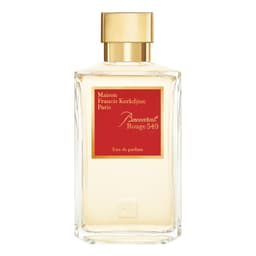
Baccarat Rouge 540 is the eau de parfum Francis Kurkdjian composed in 2014 for the 250th anniversary of the Baccarat crystal works, before taking it into his own house in 2016. Its name recalls the 540 °C that turns the crystal red. The house describes a floral amber woody fragrance built on three auras: jasmine and saffron, an ambergris accord carried by Ambroxan, and ethyl maltol for the gourmand accent.
Angela (Now Smell This) hears a disconcerting amalgam, Gaia (The Non-Blonde) a burning clarity, Victoria Frolova (Bois de Jasmin) a well-built crystalline giant that is nonetheless overbearing.
What critics say
Angela, Now Smell This
For Angela, who reviewed it on Now Smell This in February 2016, Baccarat Rouge 540 is a strange amalgam, by turns gourmand, woody floral and fougère. She found the opening too sugary, like a blood orange candy, but its salty, fizzy texture intrigued her.
Jasmine and raw cedar take over the heart, over the idea of a salty ocean; the drydown turns to a citrus fougère with lavender and sage. She reads it as four short stories that make sense together, but doubts many will love it, so disconcerting are its turns.
Gaia, The Non-Blonde
On The Non-Blonde, in March 2016, Gaia found in Baccarat Rouge 540 the clarity typical of Kurkdjian’s work, coupled with an intense heat, and an almost animalic, skin-like facet. The official list of notes does not tell the whole story, she says: the perfume evokes for her sparkling lights reflected in countless windowpanes.
Victoria Frolova, Bois de Jasmin
Victoria Frolova, who reviewed it on Bois de Jasmin in August 2025, calls it a trickster, crystalline and colossal at once. She describes an amber woody accord supported by oakmoss and Veltol, a molecule that smells of cotton candy, with Ambroxan diffusing the sweetness.
She senses a mineral and gourmand hybrid, sweet without being edible: amber seen through glass, which turns to burnt sugar and grows saltier. She praises a radiant, well-built giant, but warns that it imposes itself on others, often against their will.
More perfumes from Maison Francis Kurkdjian
Also composed by Francis Kurkdjian
- Her Eau de ParfumBurberry
- RumeurLanvin
- Mania HommeArmani
- Le ParfumElie Saab
Similar perfumes
Similar notes and family, from other houses.
- Classique CabaretJean Paul Gaultier
- Libre Eau de ToiletteYves Saint Laurent
- Eau de Rochas Escapade en MéditerranéeRochas
- Mademoiselle Rochas Eau de ParfumRochas
- Le Ballet BlancRepetto
- L'Interdit Rouge UltimeGivenchy
- Wild RoseCoach
- Rosa NobileAcqua Di Parma