
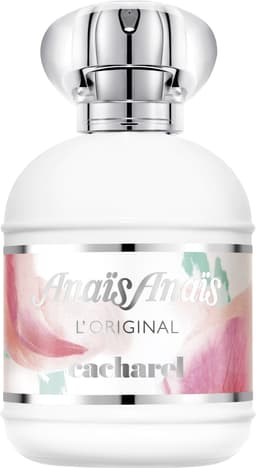
Anaïs Anaïs, the fragrance of a legend. The Cacharel brand was created in 1959 by the tailor Jean Bousquet. In 1962, he decided to move to Paris to open a workshop for the artisanal making of women's trousers. Cacharel's style is defined by a very specific fashion spirit, combining freshness, romanticism and freedom.
Anaïs Anaïs l’Original was born while the Cacharel fashion house was in full expansion. As the brand's very first fragrance with delicate flowers, Anaïs Anaïs was also the very first fragrance entirely intended for young girls, a small revolution for the end of the 1970s. To compose this fragrance, which Jean Bousquet, head of Cacharel, wanted to be symbolic of the passage from teenage years to adulthood, Cacharel called on the Firmenich company and four great names in fragrance creation.
For the first time, a collective of Firmenich perfumers worked on a fragrance: Anaïs Anaïs
The great phenomenon of 1980s perfumery, Anaïs Anaïs, (now called Anaïs Anaïs l’Original) is certainly one of those that most transformed the usual codes of perfumery. From its original brief to its creation by eight hands, from its intended audience of young people to its advertising, Anaïs Anaïs introduced a great many novelties with its original composition.
As for the concept of Anaïs Anaïs, this was the first time that a fragrance was truly acknowledged to have been composed according to criteria defined in advance, mainly commercial criteria. Thus we learn that Jean Bousquet, CEO of Cacharel, above all wanted a fragrance to express the contradictory feelings of teenage years, that age when one still hesitates between the scents of childhood and the sensuality of the woman to come.
To compose this singular fragrance, the Cacharel house called on the great Firmenich. No fewer than four perfumers worked on the Anaïs Anaïs project. It seems that Raymond Chaillan was in charge of the team made up of Paul Léger, Robert Gonnon and Roger Pellegrino. Each worked on particular accords. Thus Raymond Chaillan, entirely obsessed with the lily that Cacharel wanted so much, composed, among other things, the sensual woody accords that would do justice to the dark and sensual facets of this beautiful flower.
That is where I discovered a woody base. I knew it would be the backbone of the fragrance. A sharp, incisive but not dry odor, a vivacity that would warm and “sensualize” the initial green floral accord and give the fragrance its fullness. Raymond Chaillan, on the creation of Anaïs Anaïs, for Marie-France.
Anaïs Anaïs, or the light and dark olfactory facets of Casablanca lily
It would seem, then, that the famous Casablanca lily strongly inspired the entirety of Anaïs Anaïs's original composition.
Indeed, while Raymond Chaillan's woody accords conveyed the sensual facets of the woman-child that is Anaïs Anaïs, it is in relation to these same lilies that Robert Pellegrino made the fruity notes of blackcurrant sparkle, notably thanks to a few peppery carnations.
As for the very green top accords, they were of course designed to represent the innocence and candor of childhood. As for the floral beauties of the heart, lily of the valley, jasmine, orange blossom and ylang-ylang, they were brought to light mainly by Raymond Chaillan, to be the soft, welcoming light of Anaïs Anaïs.
The composition by the four Firmenich men had been put in competition with two others. When Raymond Chaillan's team won, there was relief and joy. Indeed, he readily states: a friend gave me a painting of lilies. I still have it. And Anaïs Anaïs was, in my life as a perfumer, the story that obsessed me the most.