
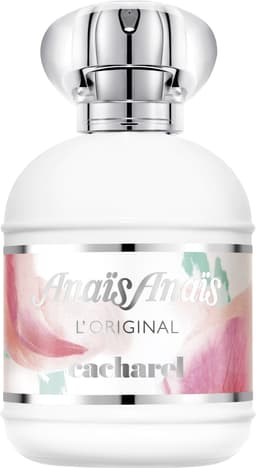
Cacharel’s first fragrance, Anaïs Anaïs came out in 1978. Four Firmenich perfumers, Raymond Chaillan, Paul Léger, Robert Gonnon, and Roger Pellegrino, composed it around the lily for young girls. Sold since 2014 as Anaïs Anaïs L’Original, it is a green floral eau de toilette: hyacinth and honeysuckle, lily, lily of the valley and rose, sandalwood and musk, in a white opaline bottle.
Critics see Anaïs Anaïs as a tender floral less demure than its image: Elena Vosnaki hails a triumph of marketing more than of composition, Chant Wagner finds in it a sensuality unaware of itself, Gaia Fishler a refined green chypre, Neil Chapman a creamy melancholy; Victoria Frolova judges L’Original a success.
Olfastory’s review
The 2011 reviews
In February 2011, Chant Wagner of The Scented Salamander discovered, beneath the innocent image, a frankly sensual fragrance, with a sensuality unaware of itself, like Eve’s before the Fall. She finds it powdery without a trace of baby talc, heady without losing its virginal freshness.
A few days later, Elena Vosnaki of Perfume Shrine judged Anaïs Anaïs highly influential for its marketing and overall design, not for the complexity of its formula. She nonetheless likes its slightly shrill green opening, its very clean lily of the valley, and the soft leather that comes through in the base.
In August 2011, Gaia Fishler of The Non-Blonde rediscovered the fragrance she used to wear with her sister. She finds it far more refined than today’s fragrances for teenagers: a green floral chypre whose white bouquet, smooth and without a star flower, floats without ever turning heady.
After 2011
In April 2012, Neil Chapman of The Black Narcissus described a deeply romantic fragrance, for women who seek reticence, almost a studied shyness. He acknowledges its conservative tone, but loves its immaculate form and its creamy melancholy, the cool sweetness of a funeral bouquet.
In March 2014, Victoria Frolova of Bois de Jasmin smelled Anaïs Anaïs L’Original at a perfumery and found it very good, despite a soapy side that does not bother her. In 2018, she judged it close to the original and considered this regulatory reformulation a success.