
Histoire du parfum
History
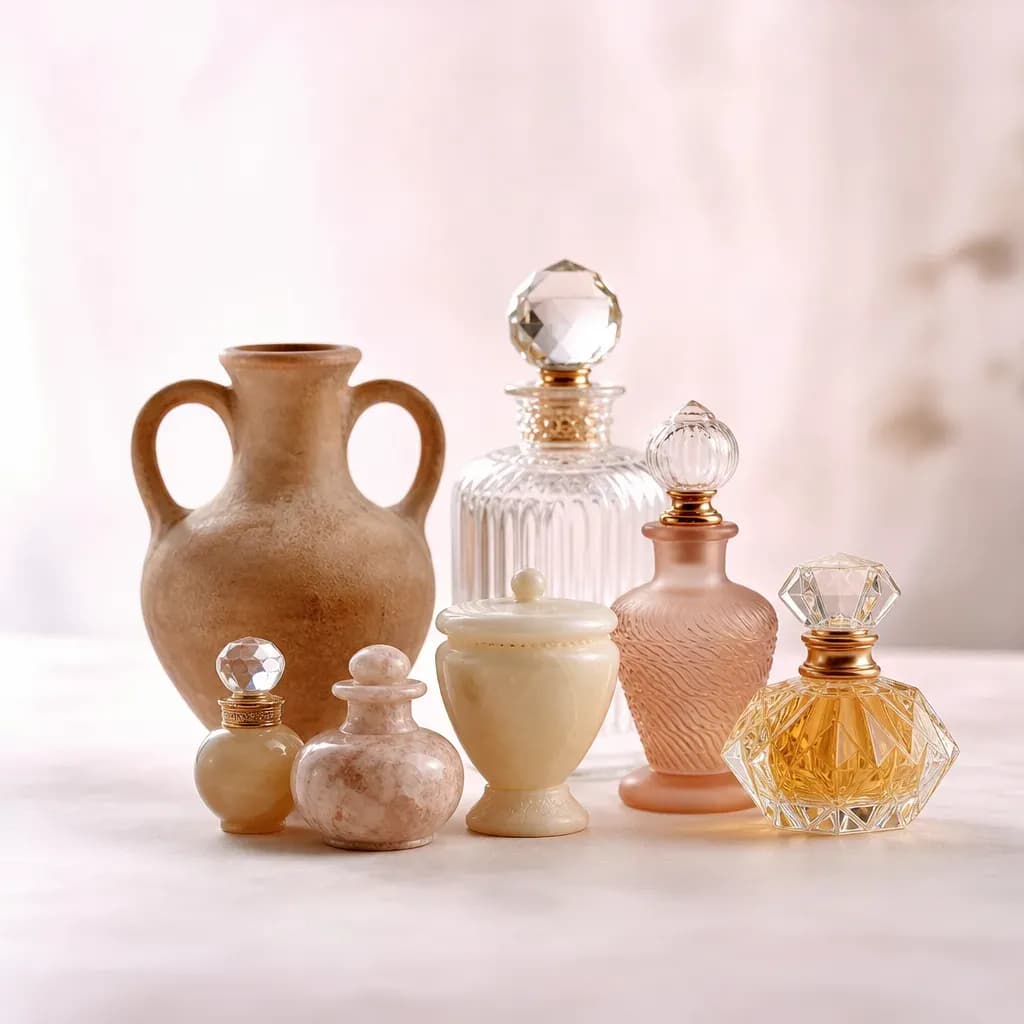
Antiquity
The earliest traces of the use of perfumery date back to antiquity. Nevertheless, it was rather reserved for the worship of gods. Similarly, raw materials were used in their raw state, directly in the form of flowers, aromatic plants or resins. The rites consisted of burning aromatic essences in honor of the divinities. The Egyptians and the Greeks considered that perfume served to exalt their beauty and their power. Moreover, the very word “perfume” comes from the Latin “per fumum,” which literally means “through smoke.” However, it is to Queen Cleopatra that we owe the beginning of perfumery as an element associated with feminine beauty. Indeed, she particularly loved immersing herself in scented baths.
Middle Ages
The first part of the Middle Ages was marked by a sharp decline in perfumery. Indeed, the barbarian invasions brought about the fall of the Roman Empire and limited the use of aromatic plants. However, the reopening of Roman trade routes from the 12th century onward made it possible to rediscover many fragrances. Moreover, it was during this period that the Chinese, the Arabs and European alchemists discovered ethyl alcohol and the distillation system. Finally, the travels of Marco Polo as well as the development of the spice trade opened the way to new flavors.
Renaissance
The Renaissance was an era deeply marked by perfumery. Indeed, nobles increasingly used perfumes to mask body odors. Bathing was not yet a daily practice, and it was necessary to cover oneself with strong, heady perfumes to mask unpleasant smells. Amber, musk, jasmine and tuberose were mainly used. Likewise, numerous explorations such as those of Christopher Columbus, Magellan and Vasco de Gama made it possible to bring back new raw materials such as cocoa, vanilla, tobacco, pepper and cardamom. Finally, it was also during this period that perfumers began to settle in Paris and that French nobility accessorized with scented gloves, to the point that the guild of French glove-perfumers was founded in 1656.
Classical Era
Louis XIV was nicknamed the “sweetest-smelling king in the world.” Indeed, the use of perfumes was omnipresent at the court of Versailles. It is even said that the Sun King had the fountains of the château's gardens scented. The monarchy's strong demand for essences led France to develop its own production. Given the favorable climate of the south of France, plantations of raw materials were established in the region of Grasse. Since then, this place has been considered the capital of perfumery. Fragrant raw materials are cultivated there and the finest perfumes are crafted there. Louis XV, for his part, continued to glorify the image of perfumery and even ordered that a different perfume be worn each day at court.
The 19th Century
The 19th century once again marked a decline in perfumery. Indeed, it was associated with the court and was therefore particularly frowned upon during the revolution. It was not until the Consulate that it returned to the forefront, thanks to Empress Joséphine and Napoléon, who were fond of exotic scents and Eaux de Cologne. Gradually, perfumery began to industrialize and was increasingly perceived as an art in its own right. It was also at this time that the first synthetic molecules appeared. The atomizer, for its part, was invented in 1870 by the writer Brillat Savarin. Other great houses such as Guerlain or Pivier also took advantage of this growth to develop the mass production of bottles. This was the beginning of perfumery as we know it today.
1900 – 1950
The 19th century once again marked a decline in perfumery. Indeed, it was associated with the court and was therefore particularly frowned upon during the revolution. It was not until the Consulate that it returned to the forefront, thanks to Empress Joséphine and Napoléon, who were fond of exotic scents and Eaux de Cologne. Gradually, perfumery began to industrialize and was increasingly perceived as an art in its own right. It was also at this time that the first synthetic molecules appeared. The atomizer, for its part, was invented in 1870 by the writer Brillat Savarin. Other great houses such as Guerlain or Pivier also took advantage of this growth to develop the mass production of bottles. This was the beginning of perfumery as we know it today.
1950 – 2000
The 1950s marked the beginning of the democratization of perfumes. They became a more accessible luxury. The hippie movement made patchouli its flagship scent. Similarly, fresh scents such as the legendary Habit Rouge by Guerlain or Eau Sauvage by Dior made their appearance. Men, for their part, gradually abandoned Eaux de Cologne in favor of perfumes proper. The 1980s then brought back headier fragrances. Virility was omnipresent and power was the order of the day. It was not until the 1990s that a return to more softness and purity was seen. Tenderness and nature were then the order of the day. It was also at this time that gourmand perfumes made their appearance, notably with the creation of Angel by Thierry Mugler in 1992.
2000 to the Present Day
Modern perfumery is marked by several simultaneous trends. Some seek greater sensuality while others turn instead toward authenticity and emotion. The chic retro spirit is more appreciated than ever. Perfumery is also less compartmentalized, and men's fragrances allow for more tenderness while women dare more impertinence. Likewise, unisex fragrances are multiplying and niche perfumes are increasingly trending.
Although globalization contributes to spreading the image of perfumery across the entire planet, some civilizations still escape this phenomenon today. In Oceania, for example, people still rub their bodies and hair with plants. Similarly, floral offerings to divinities are still practiced in Asia. In any case, perfumery still seems to have a bright future ahead of it, and the many technical advances already promise to captivate our sense of smell in the years to come.