
L'Islam
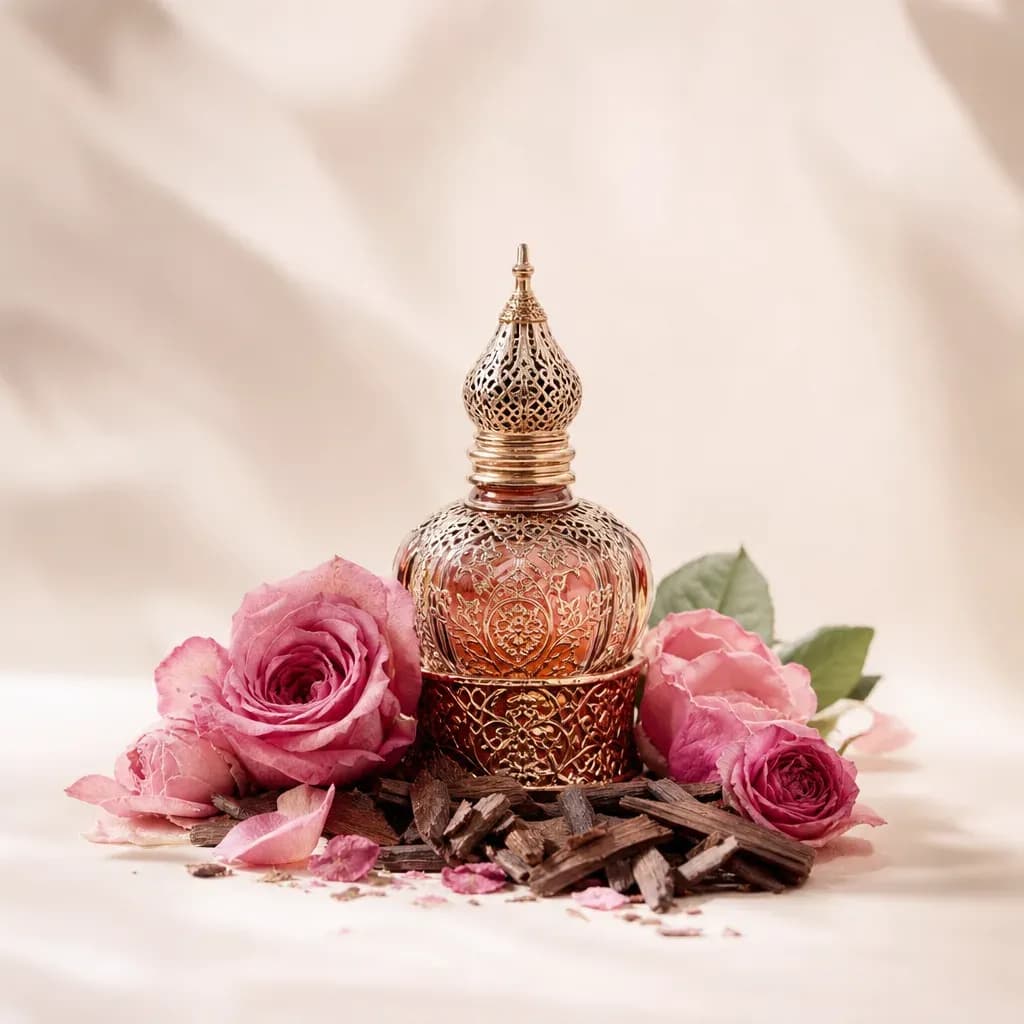
Islamic culture and the sciences of the Arab world in the service of perfumery
Muhammad once said: women, children, and perfumers are those I love most in the world. This statement thus made perfume one of the most sacred products of Muslim worship. It was then imbued with spiritual meaning without being stripped of its hygienic and pharmaceutical function. Likewise, combined with the extensive scientific knowledge of the Arabs, perfumery became an increasingly refined art during this period.
Arabia, a land favorable to perfumery
If perfume is a very important ingredient in Eastern countries, it is first of all because this region lies on land favorable to the cultivation of plants. Arabia is the land of aromatics par excellence. Indeed, the Latin poet Propertius spoke of Arabia of a thousand scents. Likewise, the poets Hafiz and Saadi evoke in their works the rose as the flower whose scent is most prized in the Arab world, along with that of musk. So if Muslim countries are known today for their many scents and their atmosphere laden with spices and flowers, this is nothing new. Moreover, for centuries, rosewater has been used there to scent the rooms of homes. Likewise, it is very often found in certain dishes such as sweets, sorbets, or Turkish delight. Coffee is regularly blended there with ambergris, and custom dictates that the walls of the cups used for drinking be impregnated with fragrant resins. Likewise, the Arabs possessed extensive scientific knowledge during the Middle Ages. Herbs were widely used for this purpose to treat various ailments. Likewise, although the Arabs did not originate the process of distillation, they considerably improved this technique and spread it throughout Europe.
The sacred meaning of perfume for the Arabs
At the same time, perfume is an integral part of religion, and the Quran speaks of it many times. Thus, the Muslim paradise is said to be imbued with numerous sweet scents. Likewise, women are said to be made from the purest musk. As with many civilizations, Islamic rites were thus accompanied by perfume. Moreover, men were invited to go regularly to public baths to purify themselves, while Muslim women present in the harems devoted most of their time to enhancing their natural beauty. Finally, it should be noted that, even today, Muslims are permitted to wear perfume during Ramadan without invalidating the fast. The Fatwa specifies in particular that, in general, scents, whether released by perfumes or not, invalidate neither the obligatory fast of Ramadan nor any other obligatory or supererogatory fast.
Islamic culture and the Arab people played a particularly important role in the rise of perfumery. They managed to preserve their sacred traditions and the use of perfume in their rituals while combining it with a technical dimension whose advances were considerable.