
L'Egypte
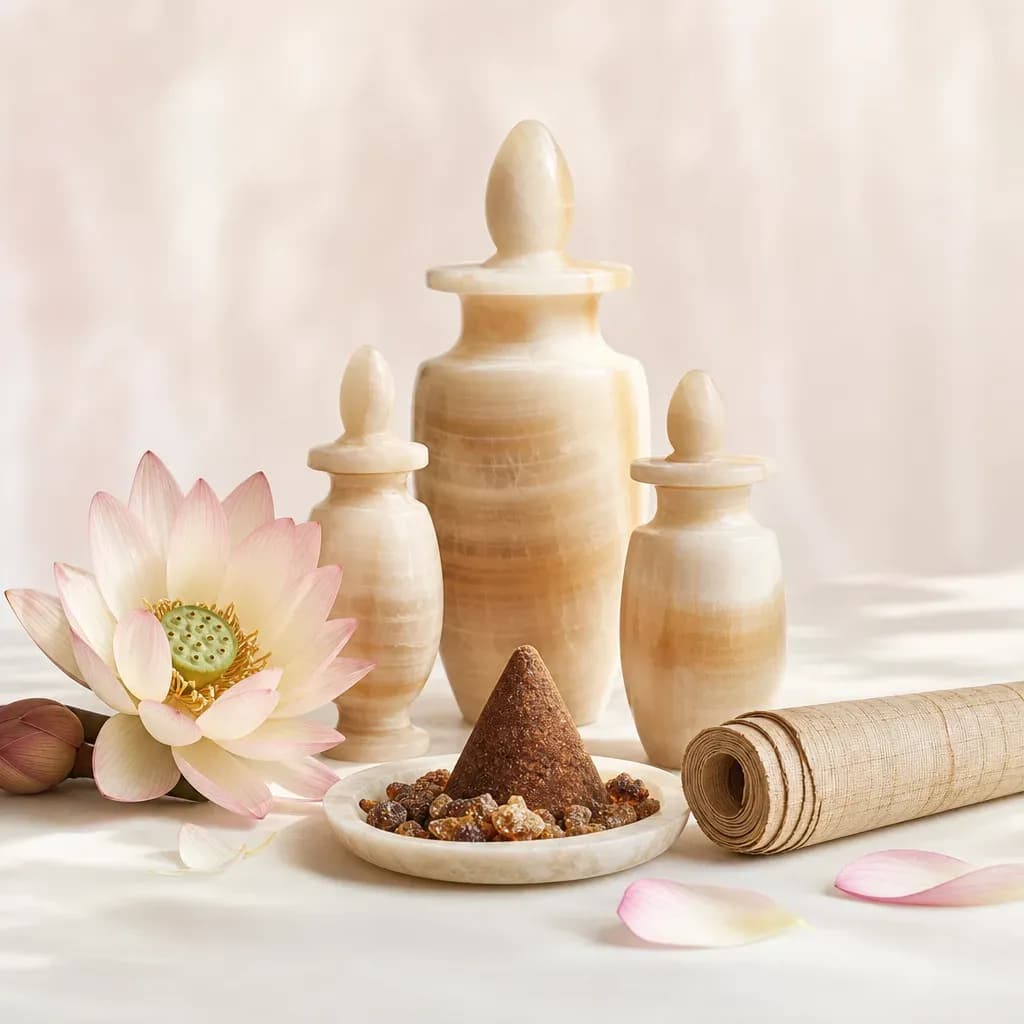
The Egyptians' love of perfume
The Louvre museum has a large gallery devoted to the era of Ancient Egypt. Among the many pieces displayed there, a painted limestone fragment depicts a servant presenting a mirror and a kohl case to her mistress, who is nursing her child. It thus attests to the Egyptians' attachment to cosmetics. Among the most prized products of the time, perfume stood out as a favorite.
Perfume as a link between heaven and earth
If the Egyptians held such a particular love for perfumery, it was above all because they saw in this product an indisputable means of creating a link between men and the gods. As such, perfumes were present in every ritual. They served to purify men and took part in every important stage of human life, up to the moment of funerary embalming. The Egyptians said that powerful scents favored the elevation of the soul. Likewise, scented offerings were regularly made to the gods to secure their protection. For example, at the time of death, embalming served to preserve bodily integrity. Similarly, every morning, priests performed the ritual washing of the statues representing the Egyptian deities. These priests, moreover, specialized in aromatherapy, and it was they who prepared the aromatics to be burned as offerings in a room located near the places of worship. All sorts of ingredients were used, whether flowers, aromatic herbs, resinous woods, or honey. The recipes for the scented products used in the rituals were, moreover, carefully guarded. They were passed down only orally and were never written down, so as to prevent their disclosure.
The use of perfume as a weapon of seduction
Nevertheless, just as in our own time, perfume was also used as an asset of seduction. Its odorous and aesthetic power was highly prized among the Egyptian population. Thus, mortals did not hesitate to adorn themselves and to use the scented substances of the time to mask their body odors and display a certain elegance. The two most widely used raw materials of the time were, in this case, incense and myrrh. These were imported directly from Somalia and northern Ethiopia. Other fragrant materials, however, also arrived from Libya, Arabia, and the Near East. The Egyptians thus also sourced pine oil, woody notes, and spices. They were already eager for discovery, seeking out varied materials endowed with both aesthetic and medicinal properties. Moreover, the Egyptians had already thoroughly mastered the art of aromatherapy. All the essences created were then held in a kind of enormous clay jar, similar to the three thousand examples discovered in the tomb of Tutankhamun, whose scent still lingers to this day…
Unquestionably, the Egyptians are today regarded as the people who paved the way for all technological advances in perfumery. They were behind the earliest uses of scented notes and the earliest discoveries in the field.