
Rome et la Grèce Antique
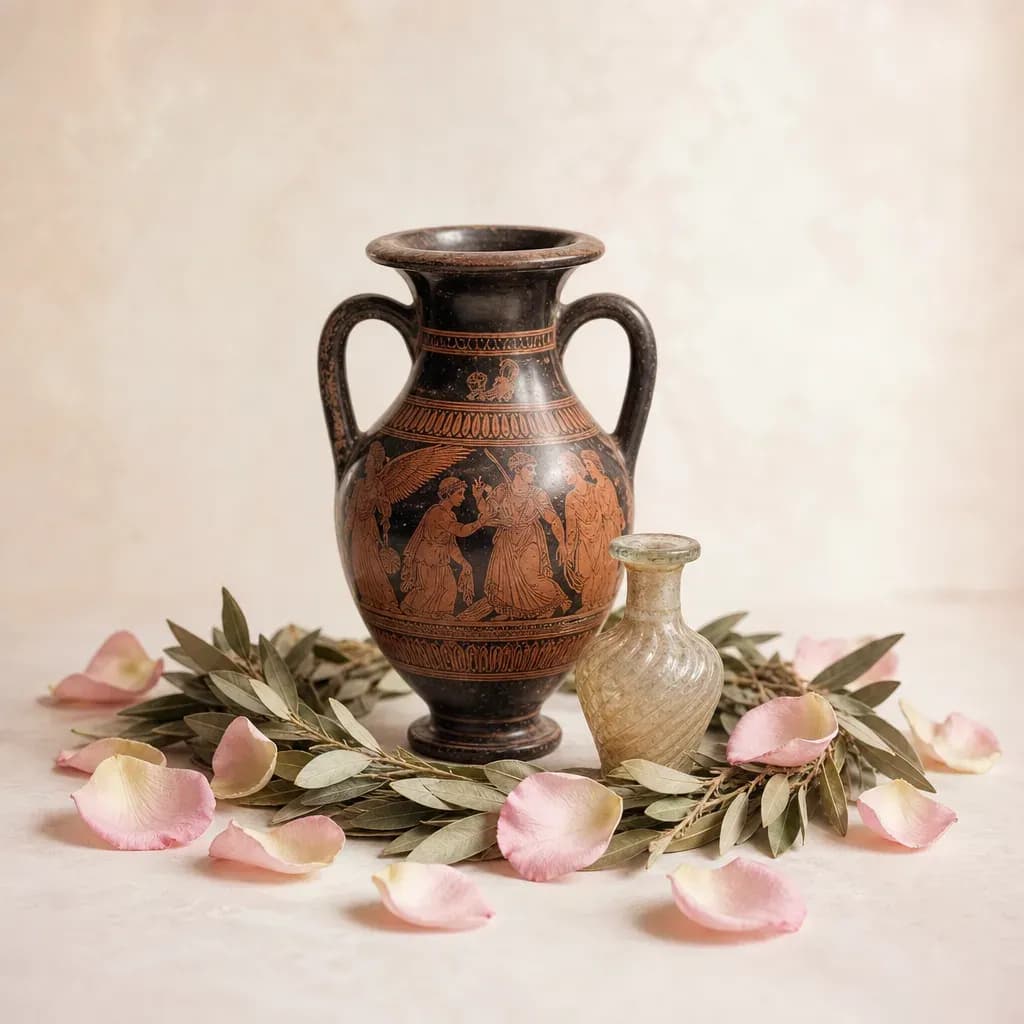
Perfumery in the time of Rome and Ancient Greece
Antiquity marks the beginnings of the worldwide reach of perfumery. This period is marked by two quite distinct peoples: the Greeks and the Romans. Beyond the numerous quarrels that set these two civilizations against each other, many historical studies have shed light on their way of life. It turns out that perfume was already omnipresent in the habits of the time.
Ancient Greece and the sacred meaning of plants
If Egypt is considered the mother of perfumery, it did not fail to pass on its knowledge to the Greek people, as well as to the Cretans and the Phoenicians. This knowledge was transmitted through their maritime relations. Strong similarities can thus be found between the sacred meaning of perfume used in Ancient Greece and its use in Egypt. Moreover, in the Cretan-Mycenaean period, around 1500 BC, the Greeks believed in the existence of divine beings revealed through aromatics and perfume. They were convinced that the many aromatic plants found in nature were of divine origin. Perfumes thus proved to be essential ingredients in the celebration of worship. Offerings were made at every ceremony, and many fragrant substances such as myrrh or incense were burned there. Likewise, the most important events in people's lives were marked by the presence of scents. Every ritual was accompanied by fumigations and scented anointments. Aromatics played a purifying role, particularly during funerals, even facilitating passage into the afterlife. This is why the deceased in Ancient Greece were wrapped in perfumed shrouds. They were then burned or buried with fragrant plants such as rose, lily, or violet, flowers regarded as symbols of eternal life.
Body hygiene for the Greeks
Furthermore, beyond the sacred meaning of perfume, the Greeks were also very attached to bodily hygiene and to the beauty of the being. They thus used plants in the form of fumigations, frictions, or baths. Indeed, public baths were very important places at the time. They were widely frequented by both men and women, smelled pleasantly of flowers, and served as places of socialization. Likewise, as a sign of hospitality, it was customary to bathe guests' feet in scented basins and to offer them all sorts of fragrant products such as flower garlands, clove oil, or flavored wines. It should also be noted that medicine was gradually developing, and the Greeks also used many plants as remedies.
Perfume for the Romans
While perfume was hardly used in the era of archaic Rome, contact between the Roman people and the Etruscans and Phoenicians helped expand the Romans' knowledge of perfumery. Perfume was also one of the major commodities brought back by the Romans from their conquests. They gradually began to appreciate the properties of various fragrances. The first scents to be introduced into Ancient Rome were those of myrtle, Spanish broom, labdanum, and pine. Thus, from the Republic to the Empire, perfumes experienced tremendous growth, sometimes to the point of excess. Like their neighbors, the Romans began using scents for their most important rites, such as marriage or funerals. Indeed, upon the death of Pompey, the equivalent of a year's incense production in Arabia was burned! Likewise, bathhouses grew considerably in scale, allowing all Romans, including the poor, to wash, and spreading the use of sapo, a foaming paste that was the ancestor of soap. At the same time, physicians wrote numerous works dealing with the curative properties of certain plants. Aromatics and plants thus became key elements of the medicine of the time, sometimes even at the expense of the mystical dimension of certain scents. So, while the religious value of perfume gradually diminished, technical advances in perfumery and aromatherapy were considerable. Indeed, some texts attest that the Romans were already using distillation. Finally, it should be noted that it was also during this period that glass was discovered, in the first century BC. Easy to work with and not retaining odors, it allowed the Romans to create the first perfume bottles.
Thus, the era of Ancient Greece and Rome is considered a landmark moment in the history of perfumery's rise. Nevertheless, not all the illustrious figures of the time were entirely in favor of it... Cicero said, moreover: No smell is a good smell! while Pliny said of perfume: Such is this object of luxury, and of all the most superfluous. Be that as it may, if the fate of fragrant materials is anything to go by, it is clear that fervent admirers of perfume were far more numerous.