
Perfume Manufacturing Techniques
techniques
Expression for obtaining the scent of citrus fruits
Expression is an extraction process reserved solely for citrus fruits. It is used both for the creation of fragrances for men and fragrances for women. Expression is a pressing extraction method. However, only the peel of citrus fruits is rich and fragrant enough to be expressed simply and directly in the form of a natural essence. The peel is first separated from the fruit. It is then mechanically pierced with small holes until the zest is obtained. The resulting fruit extract is then decanted and filtered through wet paper. In this way, the perfumer separates the watery parts from the essential oils. Today, this manufacturing method is mainly carried out using centrifuges. Indeed, manual expression would be far too costly for perfumers, hence the mechanization of this ancestral technique. This process produces a very fresh and invigorating scent.
Distillation in perfumery
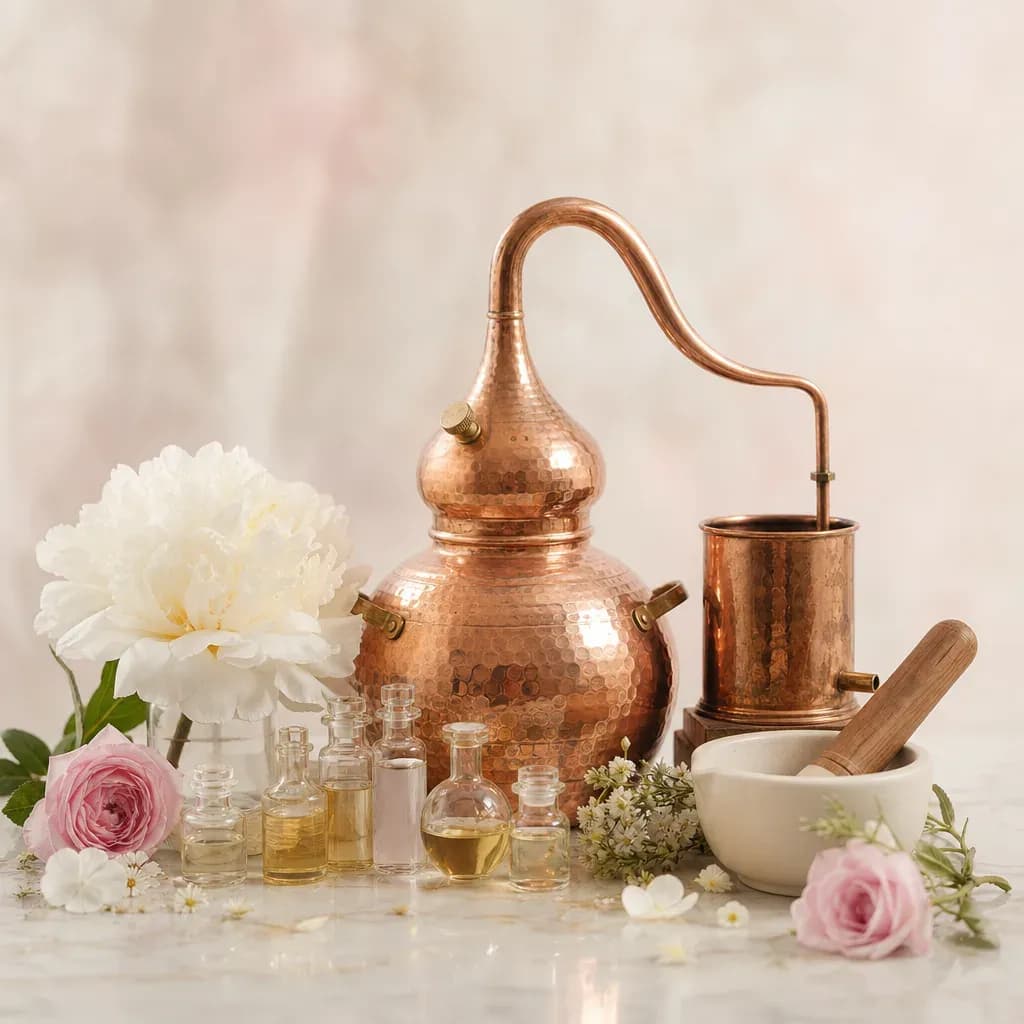
Distillation consists of separating the various volatile components of a mixture by evaporation. This operation is carried out using a still. This apparatus is a sort of steel vat fitted with a pipe into which all the plant materials needed to make a fragrance are placed, along with five to ten times their volume of water. This mixture of water and highly fragrant plant materials is then heated to a high temperature and placed under pressure. The steam produced then carries the fragrant elements up through the distillation column. These are then cooled and collected in what is called a Florentine flask (also called an essencier). It is at this point that decanting takes place. Indeed, the separation of the different elements occurs automatically due to the difference in density, since the two liquids are barely miscible. The water thus gradually separates from the fragrant elements. It is precisely these that are collected and more commonly called the essence.
Extraction to obtain perfume
Extraction is a method that involves steeping plant materials in water and solvent heated to 60°C. In the past, water was even replaced by oils. However, that era is now long gone. To carry out this operation, perfumers use various types of solvents. These may include methanol, ethanol, benzene, or carbon dioxide. These are chosen depending on the type of plants to be treated. Each of these products is volatile. Thus, as the mixture is heated, the solvents evaporate little by little until only a kind of wax remains, called the concrete. This is then mixed with a dose of alcohol, which is heated to remove the oily part. Once purified of the plant components and waxes it contains, the concrete becomes what is called the absolute.
Enfleurage to create fragrances
Enfleurage can be carried out hot or cold. These methods are used depending on the type of plants to be treated. Cold enfleurage is a particularly old process that has now almost entirely disappeared. Nevertheless, it is still used for extracting fragile flowers such as orange blossom, jasmine, or tuberose. It should be noted, however, that this is a particularly costly technique. The flower petals are hand-picked and arranged in thin layers on a film of animal fat spread over a glass plate. This is called the chassis. Every 24 or 48 hours (72 hours for tuberose), the petals are carefully removed and replaced with fresh flowers. This operation is then repeated until the fats are saturated. The resulting fragrant wax is then scraped off and heated until decanting occurs through ethyl treatment. The whole is then filtered until the absolute is obtained.
Hot enfleurage, on the other hand, is used with hardier flowers. These are immersed in animal fat that is heated several times. The flowers, for their part, are replaced with others several times until the fat becomes saturated. As with cold enfleurage, the fat is then heated, decanted, and washed with alcohol until the absolute is obtained. This technique is used much more widely than cold enfleurage.
Softact for obtaining the purest scent possible
Softact is also known as CO2 extraction. This revolutionary new process uses carbon dioxide gas as a solvent. The CO2 is placed under pressure at a temperature below 40°C. It thus reaches the supercritical stage, meaning it becomes liquid and highly malleable. Pieces of peel or flowers are then placed in a closed system through which the CO2 passes. The CO2 is then recovered, yielding fragrance extracts of an incomparable olfactory quality. The essences obtained through this process are particularly pure and contain no trace of solvent. Softact is considered a particularly gentle extraction method. This technique makes it possible to extract fragrant substances that are not very volatile, dry, or resistant to traditional techniques. As a point of reference, it is particularly used for processing spices.
Synthetic molecules for creating a scent
The use of synthetic molecules makes it possible to reproduce a natural scent so that it can be used in perfumery. Creating a new synthetic molecule often requires one to several years of research. Particularly sophisticated techniques are then employed to produce a pure, stable essence in large quantities. Each synthetic molecule results from work that is more or less long and complex. What is more, each one is the result of custom-tailored work. The complexity of each chemical reaction, as well as the number of successive steps required to achieve it or the time needed to obtain it, significantly influences the cost of these raw materials. Perfumers therefore constantly work to optimize the production chain for synthetic molecules in order to reduce the cost of these raw materials as much as possible.
Nature Print for capturing a rare scent
As its name suggests, the ambition of Nature Print is to stay as close to nature as possible. The idea is to reconstruct the finesse and complexity of a natural scent as faithfully as possible. This technique consists of capturing a scent, selecting its extract, evaluating it using gas chromatography and spectrography, and then reproducing it with finesse and precision. Nature Print is a kind of instant photograph of scents. It captures the exquisite fragrance of rare flowers, a freshly picked fruit, or a still little-known spice. Nature Print thus considerably expands the range of scents available to perfumers. Indeed, nature is an inexhaustible source of inspiration, and it is precisely this that is bottled here. The scents produced are most often fleeting and inimitable.
As should now be clear, perfumery is a field in constant evolution. Natural products are treated differently today than they were yesterday, and will be treated differently still tomorrow. Numerous scientific advances continue to expand the range of possibilities. Perfumers thus have access to ever-broader resources, and perfumery is an art that is essential to protect and preserve. No one yet knows how far the knowledge of this field will extend in the future, but it does seem that every means is being employed to keep us dreaming, carried on a simple olfactory breath.