
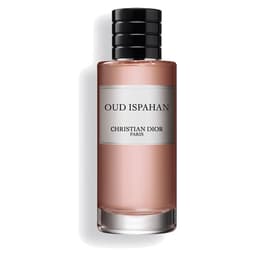
Oud Ispahan is the shared eau de parfum François Demachy composed in 2012 for La Collection Privée Christian Dior. A woody floral silhouette for the house: an enveloping oud wood against a sensuous Damask rose, which Wikiparfum rounds out with labdanum cistus, cedar, sandalwood, saffron and Indonesian patchouli. In 50, 100 and 200 ml, with an Esprit de Parfum since 2024.
Dior does not publish a pyramid. The house describes a woody floral silhouette draped in rose, a powerful oud wood interlaced with a red rose of the Orient. Wikiparfum lends it, without tiering them, Laos oud, labdanum cistus, Damask rose, cedar, sandalwood, saffron and Indonesian patchouli.
Labdanum and rose in the opening
Fishler hears an opening of big dirty rose tinted with a bitter, medicinal oud, quickly joined by an equally dirty patchouli, with a ghost note of berry that reminds her of Portrait of a Lady; Olfactorum describes a Turkish rose paired with a softer, slightly fruity oud.
Oud, patchouli and wood in the heart
Olfactorum finds the materials so intertwined that he struggles to distinguish them: a slightly earthy patchouli that catches the warm facets of the oud and the fruity facet of the rose, a sandalwood and a cedar clinging to their soft facets, the saffron indispensable to an oud.
What remains outside the declared accord
The field keeps the rose at the top, patchouli, sandalwood, oud and cedar at the heart, labdanum and saffron at the base, seven materials that Wikiparfum names, in an order that neither the house nor the reviewers break down. The honey, vanilla and tuberose that Olfactorum believes he detects, the incense that the house evokes, do not appear there.
Fishler describes the development toward a soft wood and an angular, almost incensey rose, which she attributes to the labdanum; Olfactorum a honeyed, warm base, sweetened by the cistus. Dior cites neither honey nor vanilla, but its list declares vanillin.
What the label declares
The house publishes a coded list of thirty-four lines: alcohol, Parfum, water, a synthetic amber wood, Virginia cedarwood oil, patchouli oil, citronellol, limonene, linalool, bitter orange oil, coumarin, two UV filters, alpha-isomethyl ionone, vanillin, beta-caryophyllene, geraniol.
Then come clove oil, eugenol, geranium oil, santalol, pinene, rose oil or extract, rose ketones, eugenyl acetate, terpineol, linalyl acetate, citral, farnesol, geranyl acetate, a musky lactone and three colorants.