
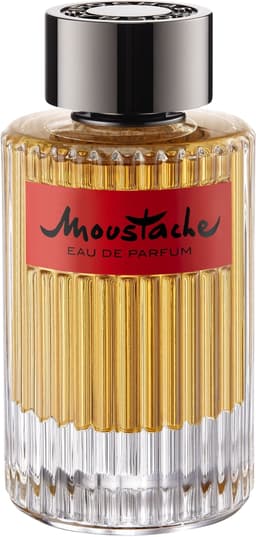
Rochas reinterprets its perfume Moustache as an Eau de Parfum. The house Rochas was created in 1925. As such, it is one of the most emblematic brands of our French heritage. As if to plunge us back into its history, Rochas has now decided to bring back into the spotlight one of its most famous perfumes for men.
To celebrate the 70th anniversary of its fragrance Moustache, the brand Rochas decided to reinterpret it as an Eau de Parfum released in 2016. In 1949, it was Edmond Roudnitska who created the perfume Moustache, and it is Nathalie Gracia-Cetto who imagined its reinterpretation. The Eau de Parfum Moustache aims to be more daring than its predecessor. It addresses seductive men, men who dare and are not afraid. Explosive and contrasted, the composition of the new Moustache has nothing to envy in the original.
Nathalie Gracia-Cetto reinterprets Moustache Rochas
Born in the heart of the perfume capital, in Grasse, Nathalie Gracia-Cetto would nevertheless leave her paradise at the age of 7 to settle in Cairo (Egypt). Nathalie Gracia-Cetto wanted at the time to make creams and turned, initially, toward pharmacy studies. She then joined the Givaudan perfumery school, before being hired there. From her exile, Nathalie Greco-Cetto kept a love of flowers, of mimosa and especially of jasmine. Truly full of talent, Nathalie has an eye for detail and loves perfection. Her perfumes wonderfully symbolize an alchemy between lightness and depth. She is responsible for such beautiful fragrances as Quatre by Boucheron, Le Mâle Essence de Parfum by Jean-Paul Gaultier and Love Chloé by Chloé.
The powerful and contrasted notes of Moustache Rochas
The composition of the Eau de Parfum Moustache opens on the tangy freshness of mandarin, immediately enhanced by pink pepper. Native to southern Asia, mandarin is particularly cultivated in Japan and China. Mandarin owes its name to the color of the silk robes worn by Chinese mandarins. Corsica was the first to cultivate clementine, starting in 1925. In perfumery, mandarin essence is obtained by cold expression of the peel. Mandarin releases soft, fresh, tangy and candied tonalities. The heart of Moustache is then contrasted and creates a sense of unease, as it combines Bulgarian rose with Atlas cedar. Native to the mountains of North Africa, Atlas cedar was introduced to Europe in 1734. It withstands cold perfectly and has been used to repopulate many forests. Its persistent, stiff needles are isolated on long branches, and grouped in tufts on short branches. In perfumery, the sawdust of a tree is steam-distilled. Atlas cedar offers tonalities that are at once soft, woody, camphoraceous and leathery. It is highly appreciated by noses. Finally, the base combines patchouli, vanilla and benzoin. Patchouli made its debut in perfumery in the mid-19th century. At that time, cashmere shawls from India were wrapped in patchouli leaves to fight off moths. However, it was not until the hippie years that patchouli became an emblem. It was then associated with a new definition of love, sensuality and sexual freedom. Today, patchouli is an expensive and luxurious raw material highly prized by various brands.