
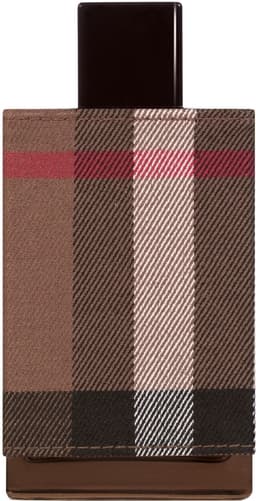
London pour Homme was released in September 2006, a few months after the women's version, under license from Inter Parfums. Antoine Maisondieu composed it at Givaudan around a leather accord that he likens to English clubs. Bergamot and black pepper open, lavender and cinnamon leaves warm the entrance, tobacco, guaiac wood and opoponax hold the base. The house gives it as woody amber; enthusiasts, for their part, smell December in it.
The house classifies London pour Homme among the woody ambers. Maisondieu recounts having started from a luxurious leather accord, chosen for what it evokes of London clubs, and having sought to put the whole house into a bottle.
Leather before everything else
Leather occupies the heart and serves as the axis. It does not take on the animalic turn of old-school leathers: the sources describe it as smooth, slightly worn, closer to armchair leather than to that of a saddlery.
Mimosa flower accompanies it and pulls it out of its stiffness. Its powdery, sun-kissed facet carries the floral share that several French readers note, alongside lavender, without classifying the fragrance among florals for that reason.
Port wine, absent from most inventories
The house names a third element in the heart of the perfume, port wine. The most widely copied note list online omits it, as it also omits black pepper: nine notes there replace the eleven of the original press release.
Two independent readings arrive at it nonetheless without having the list. An October 2006 review describes candied red fruits and a cup of mulled wine by a log fire; a French reader recognizes a familiarity she did not know how to name.
It does not, however, appear among the notes listed here: no material in the repertoire corresponds to it, and nothing has been substituted in its place. The name is written because the house writes it, and because the fruit everyone describes comes from there.
The top, pepper and cinnamon leaves
Bergamot and black pepper open, one fresh and brief, the other dry and sparking. The press release specifies cinnamon leaves rather than the bark, a distinction that online inventories erase by writing simply cinnamon.
Lavender gives the third voice to this opening. It is what earns the juice its reputation as a barbershop accord, and the extra gravity that younger readers sometimes hold against it.
The base, tobacco and wood
Tobacco leaves dominate the drydown. No reading finds cigarette in it: all describe an aromatic pipe tobacco, unsweetened, closer to the dried leaf than to smoke.
Guaiac wood brings its dry, slightly milky smoke, oakmoss its green undergrowth bitterness. This pairing pulls the leather toward the woody and keeps the tobacco far from the gourmand.
Opoponax finishes in powdery balsamic. This resin smells of sweet vanilla and amber, and it is responsible for the powdery veil that critics note at the end of the development.
Three labels for the same notes
Three labels circulate for the same eleven notes. The press release writes woody amber, the most consulted database writes spicy oriental, another still writes woody spicy. None prevails and none is absurd.
Aromatic lavender laid over oakmoss belongs to an old masculine grammar that these three labels leave aside. The divergence concerns the label, never the materials, on which there is complete agreement.