
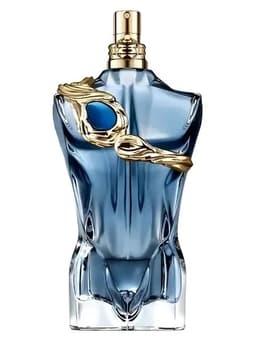
Le Beau Narcisse is a men’s eau de parfum that Jean Paul Gaultier introduced in 2026 alongside its feminine counterpart, La Belle Rosea. The house describes it as an amber musky woody scent in three movements: bergamot in the top, a powdery musk in the heart, tonka bean in the base. The torso of the bottle, draped in a gold scarf, wears a blue stone on its shoulder.
Jean Paul Gaultier classifies Le Beau Narcisse among amber musky woody fragrances. Wikiparfum, for its part, places it in the amber family, with a citrus nuance that comes from its bergamot opening.
Three notes, one per tier
The house announces only three materials. Bergamot opens with a lively freshness; musk, which it calls powdery and carnal, takes over in the heart; tonka bean brings a voluptuous warmth to the base, which the house also describes as vanilla-like and almondy.
The notes are arranged here as follows: bergamot in the top, musk in the heart, tonka bean in the base. This sparseness contrasts with the other Le Beau fragrances, where coconut accompanies bergamot, green fig, or sandalwood.
What stays out
Wikiparfum adds orange blossom and vanilla to the house’s three notes; other descriptions also add coconut and vetiver. Gaultier names none of them: these materials stay out of the classification, and vanilla appears only as vanillin in the ingredient list.
What the label declares
The ingredient list opens with alcohol, fragrance, and water. Right after come tetramethyl acetyloctahydronaphthalenes, a woody amber molecule, coumarin, the main odorant of tonka bean, and vanillin: they echo the base announced by the house.
Bergamot essential oil is listed, as are ylang-ylang, patchouli, and rose. A UV filter, avobenzone, and an antioxidant, BHT, protect the juice; four colorants, violet, yellow, blue, and red, give it its light blue tint.
The list contains neither lilial nor lyral, two ingredients banned in the European Union. Linalool, limonene, geraniol, and citronellol are among the declared allergens, as regulations require for fragrances.
Similar perfumes
Similar notes and family, from other houses.
- Late Checkout Nº13Hédonisme
- Sauvage ParfumChristian Dior
- Code ElixirArmani
- Histoire d'OrangersL'Artisan Parfumeur
- Paris - VeniseChanel
- L'Homme Le ParfumYves Saint Laurent
- Patchouli ElixirRéminiscence
- HéritageGuerlain