
Jean Paul Gaultier
La Belle Rosea
La Belle Rosea: Aquatic renaissance of a mythical beauty Seven years after giving birth to La Belle in 2019 – that audacious reinvention of Classique in which the iconic corset fell away to reveal a bare, natural femininity – Jean Paul Gaultier continues exploring its olfactory Garden of Eden with La Belle Rosea. But where the original La Belle celebrated gourmand temptation through juicy pear and torrid vanilla, where La Belle Le Parfum intensified that gourmand quality to the point of sugary addiction, La Belle Rosea stages a creative revolution by introducing, for the first time in the lineage, a crystalline aquatic dimension that radically transforms the fragrance's DNA.
- Brand
- Jean Paul Gaultier
- Launch year
- 2026
- Gender
- Women
- Olfactory family
- Floral
- Concentration
- Eau de Parfum
Where to buy
This aesthetic shift is neither a matter of chance nor a simple marketing whim. In 2026, as the market buckles under vanilla gourmands that all resemble one another, Jean Paul Gaultier bets on differentiation through aquatic freshness – an olfactory territory little explored by the house, better known for its sensual orientals than for its marine compositions. La Belle Rosea thus embodies a woman who no longer lets herself be defined by a single facet: neither purely gourmand nor exclusively floral, but polymorphous like water that takes on every shape, crystalline like a gemstone that captures and diffracts light.
Timeline of a lineage that reinvents Gaultier femininity
To grasp the full creative scope of La Belle Rosea, one must first trace the genealogy of this olfactory family, which has never stopped surprising since its emergence. In 2019, La Belle marked a bold conceptual break with Classique, its progenitor created in 1993. Where Classique enclosed femininity in a sculpted glass corset, La Belle freed it entirely: the bottle's bust was bared, a garland of flowers replaced the rigid framework, green pear and exotic vanilla took over from the powdery flowers of before. This Belle embodied Eve in her garden before the fall – innocent yet aware of her power of seduction, natural yet infinitely desirable.
In 2021, La Belle Le Parfum concentrated this formula with heightened intensity: candied pear gained presence, luminous jasmine appeared at the heart, roasted tonka bean enveloped the vanilla in an almost masculine depth. The fragrance lost in lightness what it gained in addictiveness, appealing to lovers of full-bodied gourmands unafraid of smelling like dessert. Then in 2024, a discreet reformulation subtly altered the formula of Le Parfum – a slight simplification of the pyramid, a redistribution of dosages – provoking the ire of purists who missed the complexity of the original version.
With La Belle Rosea in 2026, Jean Paul Gaultier offers neither an intensification nor a variation on the gourmand theme: this is a complete metamorphosis. The juicy pear disappears. The woody vetiver fades away. The tonka bean evaporates. In their place emerge crystalline aquatic notes, a delicate peony, and a soothed vanilla that no longer seeks to dominate but to accompany. This bold break already divides devotees of the line even before its release: some see a betrayal of the gourmand DNA, others applaud this refusal of easy solutions and this willingness to explore new olfactory territories. This aquatic-floral composition represents the culmination of a creative vision that dares to reinvent its own codes rather than repeating them endlessly.
Symphony in three movements: from spring water to gemstone
The olfactory pyramid of La Belle Rosea stands out for its remarkable economy – only three notes, as with Divine Couture before it, but arranged to create an impression of richness and depth far greater than this apparent simplicity would suggest. This economy of means is not synonymous with creative poverty: it testifies instead to a perfumery mastery in which each ingredient must carry several messages at once, where the balance between freshness and warmth is achieved through millimetric precision in proportions rather than through a multiplication of facets.
Crystalline burst: aquatic notes in the opening
From the very first spray, La Belle Rosea spectacularly breaks with the gourmand heritage of its predecessors. No juicy pear here, no sparkling bergamot to herald the fragrance's arrival with fanfare: Rosea opens on an almost mineral aquatic transparency that simultaneously evokes several mental images. One first thinks of spring water gushing between mountain rocks in springtime – pure, fresh, slightly mineral, invigorating like a splash of freshness on a sleepy face. Then comes the marine evocation: not the choppy, salty sea of conventional aquatic fragrances, but rather those tropical lagoons of translucent turquoise where one can make out every grain of sand at the bottom, where the clarity of the water almost defies belief.
These aquatic notes likely belong to the family of synthetic molecules developed over the past three decades to recreate the olfactory impression of water – a fascinating paradox since pure water theoretically has no odor. Perfumers therefore work with molecules such as Calone (which smells of melon and sea), Floralozone (which evokes ozone after rain), Cascalone (which suggests waterfalls), or the more recent Clearwood (which brings a woody-aquatic transparency). In La Belle Rosea, the intended effect seems less marine than aquatic-floral: one senses water that has passed through a garden in bloom, carrying the faint memory of the petals it brushed against without taking on their heady scent.
This aquatic opening also has an almost tactile quality: it gives the impression of refreshing the skin the way a thermal mist would, of laying an almost imperceptible hydrating veil over the epidermis. This sensation of freshness is not aggressive – it is far from the icy menthols or tangy citruses that can sting the nostrils. It is a gentle, enveloping freshness, almost maternal in its kindness. It instantly creates an impression of purity, of cleanliness in the noblest sense of the term – the kind of cleanliness that does not smell of detergent but rather of skin after a bath, hair dried in the sun, white linen fluttering in the wind.
Unlike aquatic fragrances that remain linearly fresh from start to finish, this opening of La Belle Rosea behaves like a wave that breaks and then recedes: intense during the first few minutes, it gradually fades to let the floral heart emerge without creating an abrupt break. This smooth transition attests to meticulous work on dosages and relative evaporation rates: the aquatic molecules, generally highly volatile, were probably stabilized or dosed so as not to disappear too quickly, while the floral heart builds in strength progressively rather than exploding suddenly.
Velvety bloom: peony at the center of the garden
As the crystalline aquatic notes settle, La Belle Rosea reveals its peony heart – a floral choice as rare as it is judicious in the world of contemporary perfumery. For while the rose reigns in absolute majesty, while jasmine stands as indispensable, the peony remains curiously underused despite its delicate scent and rich symbolism. In Asia, this flower embodies prosperity, feminine honor, and graceful beauty. In the West, it evokes romantic English gardens, rustic bridal bouquets, that discreet elegance that needs no shouting to captivate.
Strictly speaking in olfactory terms, peony has a scent that is difficult to describe as it oscillates between several seemingly contradictory registers. First, there is a slightly green, almost watery freshness that creates a natural continuity with Rosea's crystalline opening. This vegetal facet evokes the freshly cut stem, the crumpled leaf, that chlorophyll scent given off by bouquets of fresh flowers when one changes the water in the vase. Then comes the petal sweetness – velvety without being powdery, suave without being heady, delicate without being bland. Peony smells of silk petals, that texture at once firm and fragile that invites a fingertip caress.
But what truly sets peony apart in La Belle Rosea is its ability to remain light despite an assertive presence. Unlike jasmine, which can quickly turn heady and heavy, unlike tuberose, which imposes its almost animalic sensuality, peony maintains an airy, almost vaporous quality that keeps the fragrance from tipping into the register of heavy, classic florals. It adds volume without adding weight – a remarkable technical feat in a composition seeking to marry aquatic freshness and vanilla warmth without these two poles canceling each other out.
In the Garden of Eden spirit that runs through the entire La Belle line, this peony embodies the perfect flower of that earthly paradise – not the too-obvious rose with its thorns recalling the fall and sin, but a generous flower, round and opulent in shape while remaining innocent in scent. The peony in Rosea has an almost childlike quality: it smells of sweetness without ulterior motive, of beauty without calculation, of sensuality without a seduction strategy. It is the flower one gives out of friendship rather than passion, the one picked for oneself rather than to impress.
Perfumers likely worked the peony through a reconstructed accord – the natural flower being difficult to extract and yielding unstable absolutes. This accord probably combines rose notes (for floral roundness), lily of the valley (for green freshness), lychee (for that almost fruity-watery quality peony possesses), and perhaps a touch of ionones (those molecules that smell of violet and bring a velvety texture). The result? An idealized peony, more beautiful and more stable than nature itself, a dream peony that would never wilt in its crystal vase.
Amber sweetness: vanilla tempered in the base
It is in the background that La Belle Rosea reconnects with its gourmand predecessors: vanilla, the olfactory signature of the entire La Belle line since 2019, makes its appearance but in a considerably calmer version, almost unrecognizable compared to the torrid, heady vanilla of previous editions. Here, vanilla no longer shouts its gourmand addictiveness: it whispers its comforting sweetness, it suggests its enveloping warmth without ever imposing its sugary presence.
This vanilla in Rosea likely belongs to the family of so-called sheer or transparent vanillas – modern vanilla accords stripped of their heaviest facets (syrupy coumarin, candy-like ethylvanillin) to keep only the airiest essence of the pod. One thinks of those white, almost milky vanillas that evoke vanilla almond milk more than thick pastry cream. This vanilla smells of perfumed skin rather than dessert, of soft cotton rather than caramel, of a pillow feather rather than a tart.
But Jean Paul Gaultier does not settle for a sweetened vanilla alone: the amber descriptor accompanying the fragrance's description suggests that this vanilla has been enriched with other resinous materials to create a more sophisticated amber depth. One imagines the discreet presence of benzoin (for its balsamic-caramelized facets), perhaps a touch of labdanum (for that slightly leathery warmth), or amber musks that create a golden halo around the skin. This amber-vanilla base does not seek to fix the fragrance by force, as massive synthetic woods or heady musks would: it envelops rather than chains, it warms rather than weighs down.
The genius of this base lies in its ability to unify the composition without betraying its aquatic-floral spirit. Too present, the vanilla would have pulled Rosea back toward the gourmand territory of its predecessors and erased all the singularity of its crystalline opening. Too discreet, it would not have been enough to anchor the fragrance on skin, and Rosea would have evaporated within hours like a simple summer eau de toilette. By finding this millimetric dosage – enough vanilla to reassure fans of the line who expect this signature, not enough to dominate the aquatic-floral facets that make up the juice's novelty – the perfumers pull off a seemingly impossible equation: creating a radically different fragrance while maintaining an olfactory family resemblance to La Belle.
Precious sculpture: a bust adorned with rose gold and garnet
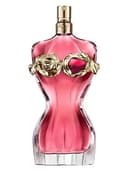
If Jean Paul Gaultier fragrances sell as much for their juice as for their bottle, La Belle Rosea does not depart from this tradition of the bottle as a work of art. The bare female bust that has characterized the entire La Belle line since 2019 is here adorned with unprecedented ornamentation that turns the bottle into a true piece of jewelry. Gone is the simple garland of golden flowers from the original La Belle, gone is the solid gold of La Belle Le Parfum: Rosea is crowned with a golden rose set with a blood-red garnet that sparkles like a gemstone atop the bust.
This iconographic choice of the rose – which incidentally gives the fragrance its name, Rosea deriving from the Latin rosa – is obviously not incidental. In the Western collective imagination, the rose embodies love, passion, absolute beauty. But by presenting it as a golden jewel rather than a fresh flower, Jean Paul Gaultier performs a fascinating semantic shift: this rose does not wilt, does not fade, never loses its petals. It is an eternal rose, an ideal rose, a Platonic rose existing outside time and decay. It evokes those golden roses jewelers create for lovers wishing to give a flower that lasts forever, those botanical sculptures that turn the ephemeral into the permanent.
The garnet set at the heart of this golden rose adds a further precious dimension. This semi-precious deep red stone – which the Ancients called carbuncle and believed endowed with protective powers – creates a luminous focal point atop the bottle. Depending on the angle of the light, the garnet seems to glow from within, casting ruby reflections that bring the jewel to life. This play of light turns the bottle into an almost living object that changes appearance depending on the time of day and the quality of the lighting – exactly like a true gemstone revealing different facets according to how light passes through it.
The bust itself seems to have gained in refinement compared to previous versions. The glass, in a delicate, almost translucent pink, evokes less the vibrant magenta of the original La Belle than fine porcelain, rosy alabaster, that almost translucent skin quality found in some redheaded or very fair-haired women. This pink hue is not uniform: it is more concentrated at the base of the bottle and gradually lightens toward the top, creating a subtle gradient that evokes blood circulation beneath fine skin, the rose of slightly flushed cheeks, that life that surfaces beneath the epidermis.
The curves of the bust have been slightly refined – a somewhat more pronounced waist, hips a touch narrower, shoulders subtly straightened – creating a silhouette that evokes less the curvaceous pin-up than the graceful ballerina or the ethereal nymph. This morphological evolution of the bottle perfectly mirrors the fragrance's olfactory evolution: where La Belle embraced an almost carnal sensuality with its generous forms and vanilla gourmand quality, Rosea offers a more ethereal, more vaporous beauty, belonging as much to the aquatic world of water nymphs as to Eve's earthly garden.
Portrait of a modern naiad: between crystal and petal
Who is La Belle Rosea for? Jean Paul Gaultier paints the portrait of a femininity that refuses to choose between strength and softness, between crystalline transparency and floral opulence, between aquatic modernity and vanilla classicism. This new-generation Belle is no longer the gourmand Eve biting into the forbidden pear: she embodies instead the naiad emerging from the clear waters of paradise, crowned with peonies and adorned with jewels, half aquatic creature, half floral goddess.
One can easily picture her pursuing creative professions where aesthetic sensitivity matters as much as pragmatic efficiency – an interior architect specializing in spas and wellness spaces, a jewelry designer inspired by nature, a fashion photographer with pared-down compositions, a beauty content creator who favors the natural look over heavy makeup. Her relationship to beauty values sophisticated simplicity over showy ostentation, luminous freshness over heavy sexiness, discreet elegance over loud glamour.
This La Belle Rosea woman likely has a minimalist yet exacting beauty routine: a few ultra-high-quality products rather than an overflowing cabinet of cosmetics, treatments based on thermal water or hyaluronic acid that promise hydration and transparency rather than thick nourishing creams. Her wardrobe favors natural materials – white linen, pearly silk, Egyptian cotton – in simple but impeccably tailored cuts. She may collect delicate jewelry – thin rose gold rings, pendants set with fine stones, bracelets that jingle softly on the wrist – rather than imposing statement pieces.
La Belle Rosea is particularly well suited to transitional seasons and temperate climates. Its aquatic freshness makes it an ideal ally for spring, when nature awakens and the first peonies bloom in gardens. Summer allows it to reveal its full refreshing transparency – unlike vanilla gourmands that can feel stifling in intense heat, Rosea remains airy and thirst-quenching even at 30 degrees. In autumn, its vanilla-amber base brings just the right amount of comfort as temperatures drop. Only harsh winter might prove less favorable terrain: its aquatic lightness risks feeling too cool when the body craves thick, comforting cocoon fragrances.
The sillage of La Belle Rosea remains moderate and intimate – the very opposite of projection bombs that saturate a room. Within a radius of 50 centimeters, the fragrance creates a bubble of floral freshness that intrigues without overwhelming. This olfactory discretion perfectly matches the spirit of the fragrance: Rosea does not shout its presence, it suggests it with the delicacy of a flower that diffuses its scent without forcing attention. At the office, it will never bother colleagues. On a romantic date, it will invite closeness in order to be smelled rather than announcing arrival from several meters away.
Longevity ranges between 6 and 8 hours on normal skin – a respectable performance for an eau de parfum with an aquatic-floral dominant. The amber vanilla base ensures appreciable persistence: even after the crystalline peony has faded, a soft, comforting veil remains that discreetly signals one's passage. On fabric, longevity can easily reach 12 hours, the fibers retaining the amber molecules particularly well while letting the aquatic-floral facets express themselves more diffusely.
A bold reinvention of a gourmand lineage that seemed destined for endless vanilla repetition, La Belle Rosea proves that Jean Paul Gaultier retains its capacity to surprise and take creative risks even after nearly fifty years of career. By daring to break with the comfort of a proven formula to explore the unfamiliar territory of aquatic-floral-amber, the house reaffirms that innovation does not always lie in addition but sometimes in subtraction, not necessarily in complexity but potentially in masterful restraint. Between the crystalline freshness of Eden's springs and the velvety sweetness of peonies in bloom, between modern aquatic transparency and timeless vanilla comfort, between golden rose and red garnet, La Belle Rosea celebrates a truth the house of Gaultier has always proclaimed: feminine beauty need not conform to a single model, it flourishes in diversity, it expresses itself in embraced contradiction, it shines all the brighter for refusing to be confined to a reductive definition. And if being beautiful also means having the courage to perpetually reinvent oneself, then La Belle Rosea perfectly embodies this beauty-as-metamorphosis that never stops evolving.
Olfactory pyramid
- Top notesThe first minutes
- Heart notesThe heart of the perfume
- Base notesWhat lingers
Share your impressions
Create an account to keep your votes and find your notebook.