
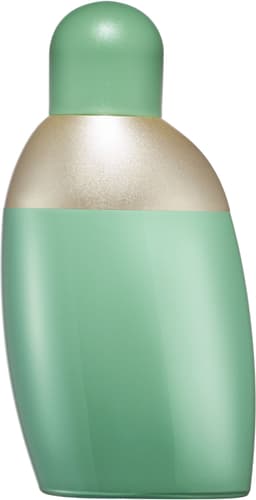
Composed by Jean Guichard, Eden was released by Cacharel in 1994. Twenty-three attested raw materials coexist in it, from bergamot to tonka bean, from water lily to patchouli, and this abundance is as much the subject of the fragrance as its reproach. The aquatic effect owes less to water flowers than to Calone, a synthetic material emblematic of the 1990s. Its veined jade opaline bottle never repeats itself quite exactly.
Six independent sources describe Eden, and twenty-three raw materials are attested by at least two of them. A note comes from the composition house, two signed reviews, the brand, a manufacturer database and a community encyclopedia.
Twenty-three raw materials, seven in the opening
The opening brings together bergamot, lemon, mandarin and peach, a green note, orange blossom and tarragon. This last material, herbaceous and anisic, explains the plastic, unsettling effect that nearly all accounts mention.
The heart contains ten. Water lily and lotus give the water flower, tuberose, jasmine, lily of the valley and rose the floral amplitude, mimosa and violet the powdery facet, melon and pineapple the fruity side.
The base retains six: patchouli, sandalwood and cedar for the woody structure, vanilla, musk and tonka bean for the sweetness that rises with the hours. Patchouli is the material carried by five of the six sources.
Calone, or what the melon is not
Eden's fruits do not come from fruit. A signed review notes that the melon and pineapple do not actually smell like either: the aquatic sensation comes from Calone, a marine molecule that became common in that era.
This molecule came into massive use as early as 1988 at Aramis, and marked 1990s perfumery. It explains why Eden's water flowers seem unreal to many, and why the fragrance ages as a dated object rather than a classic.
The accord thus rests on fully assumed synthetics. One review sees a marsh rather than a garden, another a jungle under plastic, and this claimed artificiality remains the trait that sets Eden apart from its contemporaries.
Where the sources contradict each other
Two tier disagreements remain. Water lily and lotus are placed in the opening by two sources, in the heart by two others. Orange blossom rises to the top notes for three, falls to the base for one.
Seven materials are dropped for lack of a second witness: ylang-ylang, iris, oakmoss, amber, black locust and vetiver, each carried by a single source. Gorse flower, long cited by retailers, appears in none of the sources retained and is excluded.
Jean Guichard, the hand behind Eden
Born in Grasse, Jean Guichard entered perfumery at Roure Bertrand Dupont, worked at several composition houses and joined Givaudan. He received the François Coty prize in 2000. He cultivates his own fields of jasmine and May roses.
He is credited with Loulou for Cacharel, Obsession for Calvin Klein and Concentré d'Orange Verte for Hermès. He directed the Givaudan perfumery school, founded in 1946 by Jean Carles under the Roure name; its direction now belongs to Calice Becker.
One circulating attribution does not hold: L'Interdit by Givenchy, from 1957, is the work of Francis Fabron according to five concordant sources, and is therefore excluded from his bibliography. His son Aurélien Guichard is also a perfumer.