
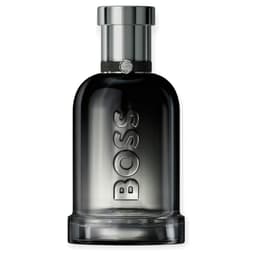
BOSS Bottled Beyond: the spirit of conquest at its peak. Twenty-seven years after the classic BOSS Bottled (1998), Hugo Boss signs BOSS Bottled Beyond Eau de Parfum (2025). Longtime perfumer Annick Menardo reinterprets the iconic apple-cinnamon accord into a ginger-leather-black wood trio. The result: a highly masculine spicy amber, darker than BOSS Bottled Parfum (2023), yet still driven by the Be Your Own BOSS mantra.
An accord announced without a tiered pyramid
Hugo Boss does not detail the composition in the classic three tiers. The house describes a duel of opposites: a vivid, fresh ginger meets a fleshy, sophisticated leather, in what it calls a harmonious duality of spices.
Ginger and leather, the two cited pillars
The house’s product pages and those of its retailers name ginger and leather as the constituent raw materials, without assigning them to top, heart or base. Wikiparfum repeats this ginger-leather pairing without naming any other raw material, and the brand announces no additional note.
What the label declares
The label lists bergamot (Citrus Aurantium Bergamia Peel Oil) and lemon (Citrus Limon Peel Oil), two citrus notes the house’s official narrative leaves unmentioned, as well as patchouli (Pogostemon Cablin Oil) and lavender (Lavandula Oil).
It also lists vanillin and coumarin, two molecules with vanilla and hay facets, eugenol, a carnation facet from clove, linalool and citronellol, floral molecules, and geranyl acetate, rosy and fruity.
Iso E Super (Tetramethyl Acetyloctahydronaphthalenes), woody, amber and velvety, opens the list right after alcohol, the word Parfum and water; the musk Galaxolide (Hexamethylindanopyran) follows immediately after, even before bergamot oil. Acetyl cedrene, woody, cedar-like and dry, appears further down.
What remains outside the declared accord
Mandarin, clary sage, benzoin and sandalwood, sometimes attributed to Boss Bottled Beyond, appear neither in the house’s official narrative nor at Wikiparfum. Only patchouli, likewise absent from the official narrative, does indeed appear on the label.