
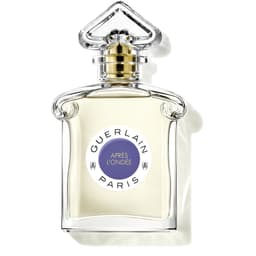
Après l’Ondée: A perfume painting signed by Jacques Guerlain... A poem, an impressionist painting, a watercolor
Released in 1906, Après l’Ondée tells the story of a storm on a beautiful spring day. When the storm ends, the sky clears and still-timid rays of sunlight appear. Après l’Ondée is a fragrance that could not be more poetic. Impressed by the scent of this rain shower, Jacques Guerlain chose here to render it olfactorily and to capture this very particular scent composed with utmost delicacy. Blended with the dampness of roses, wet grass, rain and sun, Après l’Ondée is a fragrance dazzling in its naturalness.
Après l’Ondée, Jacques Guerlain captures the scent of the rain shower with magic
Jacques Édouard Guerlain was born in 1874 and died in 1963. He represents the third generation of Guerlain perfumers. Highly influential, Jacques Guerlain has no fewer than 80 fragrances to his name. He is the grandson of the brand's founder, Pierre-François-Pascal Guerlain. He succeeded his uncle Aimé, who taught him everything about the art of perfumery. It was Jacques Guerlain who opened the boutique on the Champs-Élysées in 1912 as well as the one on Place Vendôme in 1935. L’Heure Bleue, composed in 1912, was one of his first successes, followed in 1925 by the legendary Shalimar. Jacques Guerlain can boast of having contributed to the international success of the house of Guerlain. He is responsible for great fragrances such as Mitsouko, Vol de Nuit and Cuir de Russie.
Guerlain's Après l’Ondée and its bucolic olfactory notes
The opening of Après l’Ondée is as bright as it is fresh, combining lemon and bergamot with neroli. The geographical origins of lemon lie between China and India, 2,500 years ago. Lemon would later be found along the Silk Road and would travel as far as the Middle East. Lemon continued its journey toward Asia Minor and Italy. At first, lemon was used only for its therapeutic properties; it was even prescribed by some doctors to fight fever. Lemon became known in Europe as early as the 12th century, and in Florida, which would become a major producer, in the 16th century. In perfumery, lemon essential oil is obtained by cold distillation of the fruit's zest. Lemon offers very fresh, tangy and zesty tonalities. Then, the heart of Après l’Ondée is both floral and powdery, combining iris, mimosa and violet. Mimosa is an association of curled, golden flowers of a vivid, ultra-bright yellow that one cannot help but admire. In the language of flowers, mimosa symbolizes elegance and tenderness and conveys a message of friendship. Since 1931, the town of Mandelieu-la-Napoule (Alpes-Maritimes) has been the capital of mimosa. Every year, mimosa is at the center of a great popular festival that lasts 10 days. In perfumery, mimosa gives off tonalities that are at once powdery, green and slightly honeyed. Finally, the base of Après l’Ondée is meant to be ultra sensual, even carnal, thanks to the presence of styrax, white musks, heliotrope and vanilla.