
Distillation
Manufacturing technique
The principle of distillation
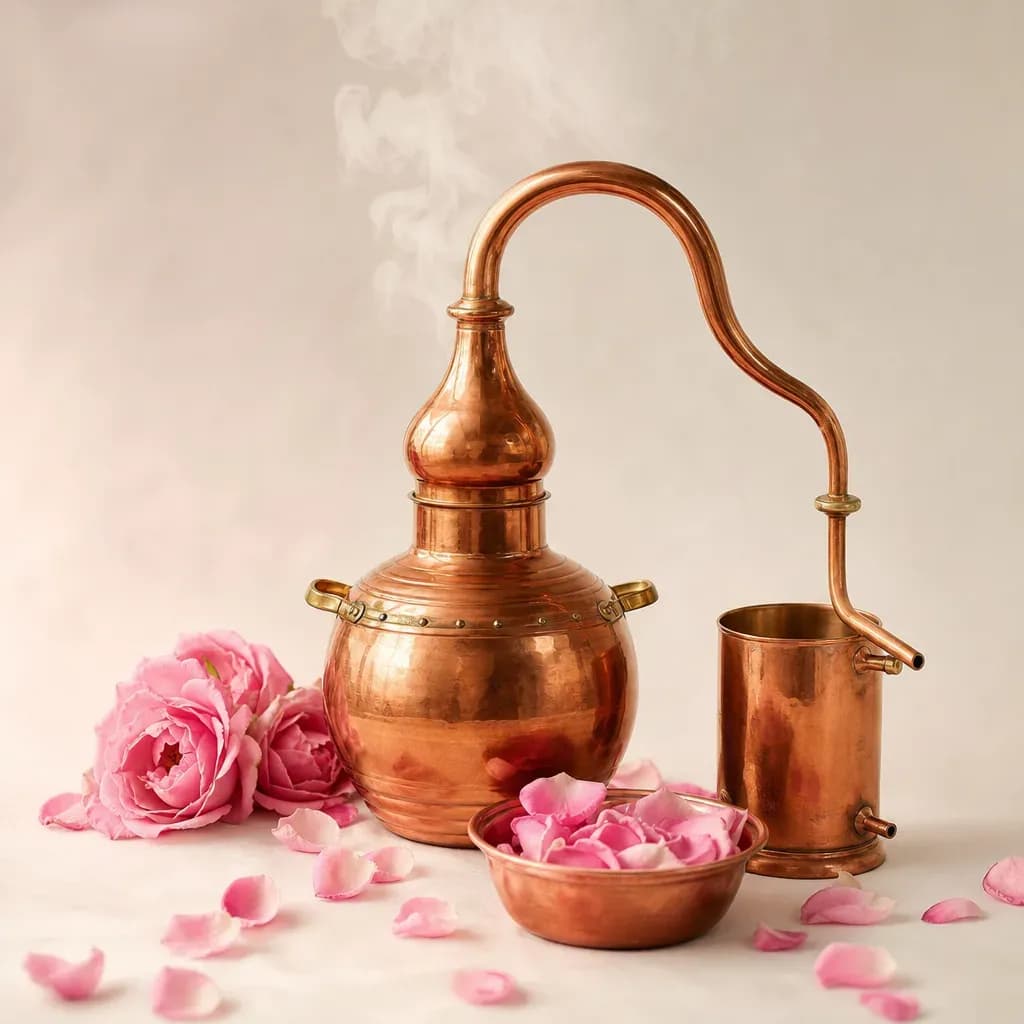
Distillation is a technique based on the evaporation of steam and its capacity to become imbued with essential oils. To do this, plants or other materials to be distilled are placed on a perforated tray located in the upper part of a still's vessel. The vessel is filled with water brought to a boil. As steam rises, it becomes imbued with the odorous compounds of the plants placed in the upper basket. The whole is then carried through a coil and then through a cooling system that causes condensation. There, the essence obtained is collected in a separator (or Florentine flask) in which the liquids separate naturally due to their differences in density. The essential oils are then collected at the surface before being used in perfumery.
The ancestral practice of distillation
Distillation has been known since antiquity. Indeed, archaeologists have discovered primitive types of stills in northern Iraq. These are estimated to date back to 3500 BC. Similarly, similar objects have been found in the Indus region, between Pakistan and China, as well as in Crete and in Egypt, in Alexandria. Likewise, a manuscript belonging to an Alexandrian alchemist, dating from the fourth century and depicting an illustration of a still, was found during recent excavations. Westerners, for their part, developed distillation starting in the twelfth century. However, it was intended primarily for medicine and reserved for physicians and apothecaries. In fact, the commercial expansion of this practice did not truly begin until the seventeenth century, eventually extending into the world of perfumery. Nevertheless, distillation remains a highly effective method and is still particularly widely used today.
The various components needed for distillation
Distillation is a process that requires few components. The essential part of this manufacturing technique lies in the choice of plants from which the aromas will be extracted. These are chosen for their odorous qualities and can sometimes reach exorbitant prices. Moreover, producing certain perfumes requires colossal quantities of flowers. In fact, five to six tons of plants are sometimes needed to obtain a single kilo of essential oil. The other essential tool for distillation is the still. There are two opposing systems. One may consist of a pot containing water at the bottom, with the plants arranged on a grid above it. The second system involves an independent boiler with pressurized steam injection entering the pot. Finally, the last necessary ingredient is water, needed to produce steam.
Of course, although widely used in perfumery, distillation is not the only manufacturing process for perfumes. Moreover, it does not apply to all products, and many different types of expertise are in fact essential to manufacture the impressive quantity of fragrances currently available on our shelves.