
Samsara: A fragrance of eternal orientalism... Samsara appeared at the end of the 1980s, a decade far more accustomed to heady fragrances than to serene oriental compositions like Jean-Paul Guerlain's creation.
In 1989, the house of Guerlain presented a fragrance radiant with spirituality: Samsara. An elixir of seduction, this fragrance is designed for a fulfilled and serene woman, exuding absolute harmony around her. Deeply inspired by Indian culture, Samsara is an overdose of sandalwood, lit up by ylang-ylang, while also carrying a strong concentration of jasmine. Floral and oriental, it wraps the wearer in generous warmth, unfolding a remarkable sillage. But what about its bottle? In fact, Guerlain's Samsara does not come in a single bottle. It is offered in two different containers.
Samsara and its bottle inspired by a Khmer dancer
To better understand Samsara's first bottle, one must immerse oneself in its world. Its name resonates as a symbol of serenity. In the Indian language, Samsara means eternal cycle of births and rebirths. It invites meditation and holds an undeniable sacred dimension. And it is precisely this that inspired its bottle. Guerlain's Samsara bottle is like time suspended in flight. Created by Robert Granai, it draws inspiration from a silhouette encountered at the Musée Guimet: that of a Khmer dancer. One recognizes its delicate curves, the fullness of femininity, and the continuity of movement. Its glass, meanwhile, is tinted a brilliant red. In Asian culture, red is a very powerful sacred symbol. Here, it contrasts with a few golden elements, such as a belt at the center of the bottle, as well as a half-moon-shaped cap. As an interesting aside, this cap evokes the eye of Buddha. Here again, it is a symbol of meditation. The name Samsara, for its part, is also inscribed in golden lettering.
Samsara, presented in Guerlain's famous Bee Bottle
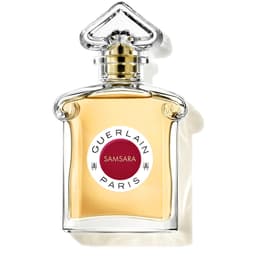
Beyond this first container, Guerlain's Samsara also comes in another bottle, one much better known and more widespread within the Guerlain line. This one is shared across an entire collection of Guerlain's great classics. It is a modern reinterpretation of the legendary Guerlain Bee Bottle. It was originally created in 1853 by Pierre-François-Pascal Guerlain, intended for Empress Eugénie, wife of Napoleon III. It is adorned with the symbol of the Empire, the bee, which has since become the emblem of the house of Guerlain. If this bottle is used here, it is because it contributed greatly to the brand's renown. It is thus a plunge into Guerlain's history. Its dome, for its part, is covered in countless facets that play with light. Its cap is covered with a finely carved transparent sphere. Finally, to echo Samsara's other bottle, a red label adorns its front face, bearing the name Samsara in golden lettering. This Guerlain fragrance comes in two different sizes, 50 or 100 ml.