
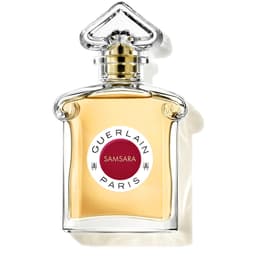
Samsara: A fragrance of eternal orientalism... Samsara appeared at the end of the 1980s, a decade far more accustomed to heady fragrances than to serene oriental compositions like Jean-Paul Guerlain's creation.
For the first time in its rich history of cult fragrances, the venerable house of Guerlain told a story before even composing the perfume. For Samsara is, above all, a legend, a gift of love given by a man to his wife, a gift that became a cult classic when the loving husband in question was named Jean-Paul Guerlain and was the appointed perfumer of the house that has borne his name for three generations. Samsara thus wears like a fragrant gift that exudes the sweetness of the East, a land that made women of the 1980s dream.
Samsara, when the house of Guerlain no longer wanted to simply compose
The house of Guerlain remains an absolute reference in perfumery, yet the 1980s and their flood of opulent, chic, and striking fragrances stole the spotlight from Chamade, l'Heure Bleue or Shalimar. It was time to modernize the image of the old house, and Jean-Paul Guerlain understood this well. The perfumer, grandson of Jacques Guerlain, would break with the house's traditions to create the story, the brief, for his fragrance, before immersing himself at his perfume organ. Samsara would offer the delicate and refined world of Southeast Asia, from Thailand to Tibet. Like a new chapter in the story of the legendary Shalimar, Samsara would take us on a journey between spicy European scents and opulent Asian flowers.
Moreover, Jean-Paul Guerlain never hid the fact that he drew inspiration for Samsara from his grandfather Jacques's work on the composition of Shalimar. This time, however, the oriental scents are more nuanced, less powerful, more refined, in order to suit the more understated desires of women at the start of the 1990s. It should also be noted that the major shift in the creative workings of the house of Guerlain would come through pitting Jean-Paul Guerlain's composition against those of other perfumers. One more motivation to compose the most brilliant Samsara possible, even though this way of working seems quite far from the traditions of the venerable house.
Samsara, or the first woody feminine fragrance in perfumery
Let us be clear: while Samsara is a very beautiful oriental, it is above all built on the innovative and majestic accord of sandalwood paired with jasmine. A jasmine which, until Jean-Paul Guerlain used it for Samsara in 1989, was exclusively reserved for Buddhist religious ceremonies, which lends the flower not only the appeal of discovery but also that of a sacred scent. Jean-Paul Guerlain would moreover be one of the very first perfumers to build a jasmine distillation business on site.
As for sandalwood, it had already been used in perfumery before Samsara, but its concentration and fine quality were, for this oriental, unprecedented.
Samsara is therefore one of the first women's fragrances to offer floral-woody accords of intense depth, where opulent ylang-ylang and jasmine flower blend into a new Guerlinade composed of tonka bean, sandalwood and vanilla. Faced with these many novelties, some would no longer find the Guerlain spirit, while others would come to acclaim Jean-Paul Guerlain's highly innovative work. The innovation and the significant changes represented by the release of Samsara in 1989 left, in any case, no one indifferent.