
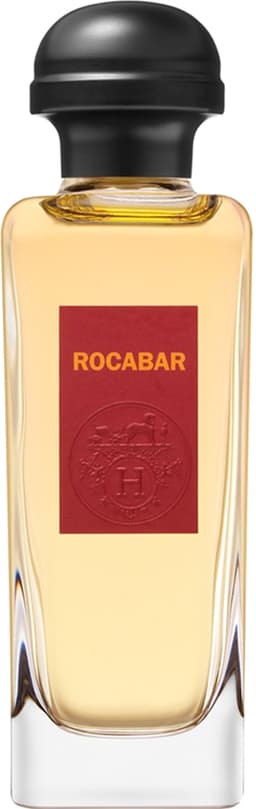
Rocabar, Hermès's spirited and free-spirited fragrance. It was in 1837 that Thierry Hermès founded the house of the same name. At first, it was a master harness maker and saddler's shop. 30 years later, Hermès's clientele was a clientele of luxury and prestige, made up of kings and presidents from around the world.
Released in 1998, Rocabar is directly linked to the equestrian world, as is the case with most Hermès fragrances. Rocabar, derived from rug, is inspired by the blanket worn by horses, striped in blue and red. If Rocabar is the perfect link between the world of the horse and that of perfumery, it remains nonetheless a tribute to the past. It is worth recalling that the house's founder, Thierry Hermès, was originally a saddler and harness maker.
Rocabar, a tribute to the beginnings of the house of Hermès
When Thierry Hermès founded the house of Hermès in 1837, he created products for horses—harnesses, blankets, straps and various equipment—which he then sold in his Parisian shop. 30 years after the shop opened, the house was rewarded with the Première Classe medal at the 1867 Universal Exhibition. From then on, the house welcomed a wealthier clientele. Indeed, Tsar Nicholas II came to equip his horses at the Hermès shop. If Hermès earned its noble reputation, it is thanks to horses, and with Rocabar, Hermès wished to pay tribute to its beginnings, to Thierry Hermès, who contributed to the house's immense success. The perfumer Gilles Romey is behind the composition. To create it, he drew inspiration from a spirited and powerful horse, but above all, a horse in love with freedom.
Rocabar and its extremely energetic fragrance notes
Gilles Romey indeed created an energetic fragrance, at once lively and intense. Rocabar opens with the lively notes of lemon and bergamot, heightened by coriander and juniper berries. The earliest traces of lemon date back 2,500 years in China and India. Initially, the lemon was a citron, and it is possible that today's lemon results from a hybrid between the citron tree and the bitter orange tree. The Romans and Egyptians used lemon for therapeutic purposes. In the 10th century, physicians prescribed lemon to fight fever. Today, lemon is among the rare citrus fruits of which every part is used. Rich in vitamin C, lemon is a highly prized citrus fruit. In perfumery, lemon releases fresh, tangy and fruity tonalities. Then, Rocabar's heart is majestic and powerful, combining noble woods such as Atlas cedar and Italian cypress with flowers such as violet, iris and carnation, all enhanced by cardamom. Atlas cedar is a magnificent evergreen conifer that can reach 40 m in height. Atlas cedar essential oil has numerous benefits, particularly for circulatory issues, cellulite or acne. In perfumery, cedar essence is obtained by steam distillation of the tree's sawdust. Atlas cedar releases woody, camphoraceous and soft odors. Then Rocabar's base is extremely sensual and powerful, combining benzoin, patchouli, vanilla and oakmoss.