
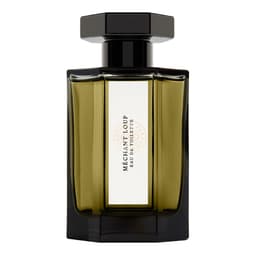
Méchant Loup appeared in 1997. Bertrand Duchaufour is its author, working from the tale of Little Red Riding Hood. The house sees in it an abstract portrait of the hazel tree: a bittersweet accord of resin, roasted hazelnuts, praline and licorice, in the smell of damp undergrowth, dry earth and sap hardened on bark.
Six materials, all declared by the house. How they are spread across tiers is the weak point of the subject, and nothing here hides it.
What the house declares
Three names recur on all its pages: hazel wood, honey, licorice. Its presentation copy adds three more, which it names in its bittersweet accord: resin, praline, dry earthy notes.
Tiers that nobody fixes
A French comparison site ranks hazel wood at the top, honey at the centre and licorice at the base. That is the order kept here, for want of better, and it agrees with the sequence Olfactorum describes on the skin: hazelnut first, the resins after.
Two other relays give two pyramids incompatible with that one and with each other, one of nine materials, the other of eight. None is taken up: the house publishes no tiering, and three contradictory readings establish nothing.
What stays out
Myrrh, sandalwood and cedar recur at several resellers, and Olfactorum does hear the myrrh. The house names none of the three: they stay in prose. Vanilla, tonka bean and star anise, carried by a single aggregator, are set aside.
What the label declares
Fourteen entries: denatured alcohol, water, fragrance, a sunscreen filter, benzyl alcohol, and nine regulated allergens — hydroxycitronellal, benzyl benzoate, benzyl salicylate, linalool, eugenol, citronellol, coumarin, limonene, isoeugenol. No substance banned in the European Union appears there. Printemps, Sephora, 24S, a Belgian retailer and an Italian retailer serve the same one, word for word.
An American retailer serves another, which carries butylphenyl methylpropional, banned in the Union since 1 March 2022. Its list does not hold for France and stays out.