
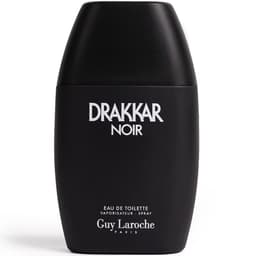
An aromatic fougère released in 1982 by Guy Laroche, Drakkar Noir bears the signature of Pierre Wargnye and revives the name of the 1972 Drakkar. Its metallic freshness comes from an overdose of dihydromyrcenol that the trade still discusses. Lavender, rosemary and bergamot at the opening, patchouli, leather and moss in the base, in a black lacquered bottle designed by Pierre Dinand. The label of the bottle sold today no longer lists the same moss.
Drakkar Noir belongs to the aromatic fougère, a family long built on lavender, coumarin and moss. Pierre Wargnye keeps its framework and pours into it a synthetic material at a proportion no one had dared before.
Ten percent of a single molecule
Dihydromyrcenol gives a cold, almost metallic lemon, drier than bergamot. Maurice Roucel puts its share in Drakkar Noir at ten percent of the formula, an order of magnitude with no equivalent in 1982.
Anglo-Saxon criticism holds onto this figure and dates to this launch the shift of the men's counter toward a clean-laundry freshness. Pierre Bourdon would double the dose six years later for Cool Water.
Where the molecule really comes from
The received idea holds that Wargnye introduced dihydromyrcenol to perfumery. Roucel brought it into menswear with Azzaro pour Homme, in the late seventies; one Anglo-Saxon record traces it back to Paco Rabanne Pour Homme, at the start of the decade.
Dates range from 1973 to 1978 depending on the source, and none place Drakkar Noir first. What belongs to it is something else, and it is more interesting: the dose, and the success that made that dose worth copying.
What the label of the bottle sold today declares
The regulatory list on the French one-hundred-milliliter bottle lists coumarin, eugenol, geraniol, citral and citronellol. It also lists Evernia furfuracea, tree moss, and not Evernia prunastri, the oakmoss that every description names.
Three labels checked across three sizes and two markets give the same indication. Oakmoss belongs to the Drakkar Noir that is remembered, not to the one that is bought, and the house itself mentions a fruity note added since.
Records that diverge
A list of twenty-five notes circulates from site to site without ever changing order. The house, for its part, announces only a handful and slips in a mandarin found nowhere else.
Mugwort, mint, basil, verbena, carnation, cinnamon and jasmine keep recurring on this single list, and nothing independent confirms them. The label does, however, list eugenol and cinnamic alcohol, consistent with a carnation-cinnamon facet.