
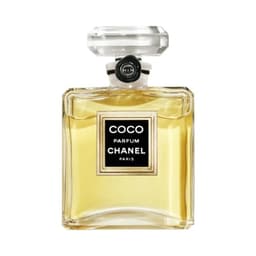
Coco Extrait is the extrait version of Coco, composed by Jacques Polge for Chanel in 1984. The house sees it as the quintessence of this amber with floral and spicy notes: Sicilian mandarin opens onto a heart of jasmine and May rose absolutes, extended by Indonesian patchouli, tonka note and benzoin.
For the extrait, Chanel speaks of a baroque score with amber, floral and spicy notes. The house names Sicilian mandarin for the top, jasmine and May rose absolutes for the heart, and, for the base, Indonesian patchouli, tonka note and benzoin.
Sicilian mandarin
A hesperidic note of Sicilian mandarin opens the extrait. This citrus links the whole Coco family, since the eau de parfum and the eau de toilette begin on the same mandarin, which Chanel describes in the same terms.
Jasmine and May rose
The heart, which the house calls voluptuous, pairs two absolutes, jasmine and May rose. This is where the extrait parts ways with the eau de parfum, which surrounds the jasmine with ylang-ylang from the Comoros and Tunisian orange blossom, without naming the rose.
Patchouli, tonka and benzoin
The base is that of the eau de parfum: Indonesian patchouli, tonka note and benzoin, in a trail Chanel calls enveloping. Benzoin resin brings a balsamic, vanilla-like softness, rounded by the coumarin of tonka.
The notes of 1984
Peach, coriander, clove, mimosa, sandalwood, opoponax or labdanum appear in the longer lists circulating for Coco: they describe the original formula. Chanel names none of them for the extrait, the eau de parfum or the eau de toilette.
What the label declares
The label published by Chanel begins with alcohol and fragrance, and beyond that details only the regulated allergens, limonene first and cinnamal last. No essential oil is named, and the list mentions neither water, nor colorant, nor UV filter.
Eugenol and isoeugenol carry the clove facet, cinnamyl alcohol and cinnamal that of cinnamon, and coumarin accompanies the tonka. No dosage appears: the list is limited to the substances subject to declaration.