
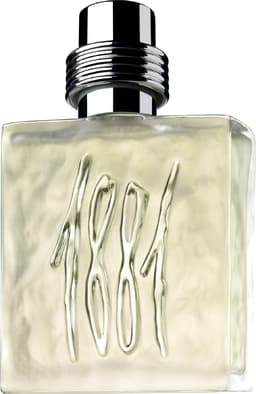
Cerruti waited twelve years after its first masculine before entrusting a second fougère to Martin Gras, in 1990. The name 1881 Homme comes from the year the family bought a textile mill in Biella. Bergamot and blackcurrant bud open, cyclamen and geranium bloom in the middle, evernyl and white musks close it. Serge Mansau designed the frosted glass bottle.
Thirty-five years of permanent exposure and a price that has become modest cloud the judgment passed on 1881 Homme. Its blackcurrant freshness and longevity are praised, while it is criticized for a banality that owes mostly to its distribution. Successive reformulations separate those who knew it in 1990 from those discovering it today.
Olfastory’s review
Few masculines will have been worn by so many people. The fragrance has sold without interruption since 1990, at a price that has remained far below that of the original launches, and this omnipresence weighs on any judgment passed on it.
From the opening to the base
The opening is crisp and cold: lemon, bergamot, a sharp, acidic blackcurrant. The heart turns floral without growing heavy, cyclamen and geranium held in check by pepper, and the ending lingers long on moss, cedar and patchouli.
What accounts for its longevity
It is credited with a cleanliness that never turns bland, long-lasting wear for an Eau de Toilette, and an accord that dates no one. It works at the office as much as in the evening, in any season, something few fougères of its generation manage.
Where opinions diverge
Two criticisms recur. Its massive distribution has made it anonymous in the eyes of those who encounter it everywhere, and its resemblance to the aromatic freshnesses of the 1990s makes it come across as a dated fragrance.
The floral bouquet of the heart is also debated. Those expecting a straightforward aromatic find it too floral; those looking for a masculine floral see in it precisely what sets 1881 Homme apart from its shelf neighbors.
What has changed in the juice
Those who kept a bottle from the original period describe it as denser, more distinctly chypre. Regulatory restrictions on moss extracts make the gap credible, and the current label declares none: a molecule now plays that role.