
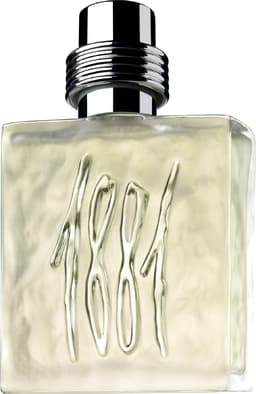
Cerruti waited twelve years after its first masculine before entrusting a second fougère to Martin Gras, in 1990. The name 1881 Homme comes from the year the family bought a textile mill in Biella. Bergamot and blackcurrant bud open, cyclamen and geranium bloom in the middle, evernyl and white musks close it. Serge Mansau designed the frosted glass bottle.
Martin Gras composed 1881 Homme for a house that had only one masculine fragrance to its name. The brief held two contrary requirements: the old codes of men's perfumery, and the modernity the couturier was already imposing on his fabrics.
A citrus opening cut with blackcurrant
The opening is citrus and green: bergamot, lemon, galbanum. Blackcurrant bud adds a sulfurous, almost fruity acidity, one that did not belong to the masculine wardrobe of the time and that lavender and basil immediately temper.
This blackcurrant is the fragrance's recognizable signature, the one that counter descriptions cite before any other. It gives that biting freshness which thirty-five years of continuous distribution have failed to wear down.
A floral heart held by pepper
The heart is frankly floral: cyclamen and geranium, two materials that 1980s men's perfumery used with caution. Juniper brings a resinous bitterness, and black pepper keeps the whole from tipping into sweetness.
This is where the fragrance's wager plays out. A bouquet of this kind then belonged to feminines; it holds here because nothing around it softens it: no sweet fruit, no vanilla, no milky note.
A base where evernyl makes the chypre
The base brings together patchouli, cedar and vetiver over a bed of white musks. Evernyl, a synthetic molecule with the scent of oakmoss, takes the leading role there and pulls the ending toward a distinctly chypre accord.
Coumarin completes the fougère reading. It appears, moreover, on the ingredients list printed on the back of the box, alongside limonene, linalool, geraniol, hydroxycitronellal and eugenol.
This eugenol does not prove the presence of carnation, as is sometimes claimed. Basil naturally carries it, as does ylang-ylang, and the molecule serves as an allergen marker, never as proof that a specific flower is part of the formula.
Three notes whose placement is debated
Three materials shift tier from one list to another: lavender and basil, given sometimes in the top, sometimes in the heart, and juniper, which travels in the opposite direction. Their presence, however, is beyond doubt.