
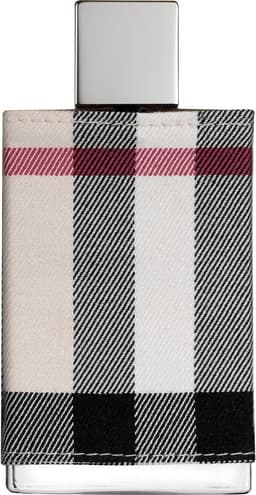
London pour Femme is the white floral that Burberry dedicated to its city in 2006. Dominique Ropion placed rose and honeysuckle in the top notes, a heart of tiare flower, jasmine and peony, and a base of sandalwood, musk and patchouli. Rachel Weisz, photographed by Mario Testino, was its face, and the bottle designed by Christopher Bailey and Fabien Baron wears a tartan cover that makes it as much a house accessory as a fragrance.
Dominique Ropion signs London pour Femme alone. The 2006 press kit and the Now Smell This perfumer database credit his name without a co-author, whereas a long series of retail pages add Jean-Marc Chaillan.
His career passed through Roure Bertrand Dupont, Florasynth and Dragoco, before IFF, which he joined in 2000. The Cosmetic Valley international perfume prize was awarded to him two years after London pour Femme.
The brief was descriptive: a floral for a feminine clientele aged twenty to fifty, cosmopolitan and modern, and a capital to be put into a bottle. The result is a white bouquet more sun-kissed than misty.
Two flowers in the opening, and not a single citrus
Two flowers open the bouquet, without the slightest citrus. The rose here is that of English gardens, rounded and slightly sweet; the honeysuckle carries its nectar smell, green at the edges, almost honeyed.
Honeysuckle is the flower wearers cite most. It is an unusual choice in the mass market, where this material usually serves as an accent within a bouquet rather than as an opening.
Mandarin, long carried by lists copied from one retailer to another, does not appear in either the brand's official description or the 2006 press kit. It is not part of the formula described by the house.
Three white flowers, and a clementine added later
Tiare flower, jasmine and peony form the body of the bouquet. Tiare flower is a Tahitian gardenia macerated in coconut oil, a creamy, milky material, both floral and fatty.
The jasmine here is clean and bright, without the animalic heaviness of the most concentrated extracts. Peony, which does not exist as an extractable raw material, is a reconstruction built on rosy, watery materials.
A signed review describes a jasmine that overtakes the rose after about ten minutes, and a tiare flower that is difficult to isolate within the floral mass.
Clementine is the point where the house's documents diverge. The official description now cites it, as zest, in the heart; the press kit released in 2006 names no citrus at all.
The gap may stem from a rewriting of the marketing copy, from a reformulation of the juice, or from both. No document settles it, and the note is retained with this discrepancy stated rather than concealed.
A base of three materials the brand calls sun-kissed
The base is short and legible: three materials, no surprises. The sandalwood here is creamy and milky, the patchouli earthy and lightly camphoraceous, the musk of a powdery cleanliness, more soapy than carnal.
The 2006 press kit speaks of a veil of musk, a phrasing that well describes the material's intended role: a link between the flowers and the wood, rather than a standalone character.
The official description calls these three notes sun-kissed, an unexpected term for an earthy patchouli. It mainly conveys the house's intention: a warm base, never dark, never nocturnal.
The mention of white musks, long carried by copied lists, does not appear on any house document, which simply writes musk without qualifier. The word matters, since white musks name a precise family of synthetics.
Fresh floral or oriental floral: the brand writes both
The official description classifies the fragrance among fresh florals; the copy distributed to retailers speaks of an oriental floral. Both formulations come from the brand, and the gap between them is the point.
The patchouli and the wood pull toward the second classification, the dominant white floral toward the first. A sun-kissed bouquet set on an earthy base allows both readings without either being wrong.