
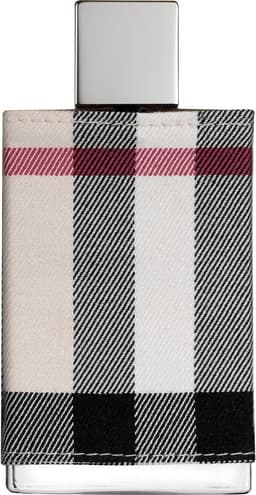
London pour Femme is the white floral that Burberry dedicated to its city in 2006. Dominique Ropion placed rose and honeysuckle in the top notes, a heart of tiare flower, jasmine and peony, and a base of sandalwood, musk and patchouli. Rachel Weisz, photographed by Mario Testino, was its face, and the bottle designed by Christopher Bailey and Fabien Baron wears a tartan cover that makes it as much a house accessory as a fragrance.
A mass-market white floral that keeps its promise of a bouquet but misses that of its name: honeysuckle and jasmine carry the juice, London remains a label argument. Elegant, very legible, risk-free, and that is also its limit.
Olfastory’s review
Honeysuckle ahead of rose
The announced top note puts rose first. On skin, it is honeysuckle that stands out, green and honeyed nectar, with rose serving as a sweet base rather than the subject.
This mismatch is part of the pleasure: honeysuckle is rarely used in an opening, and its warm-flower smell sets the bouquet apart from the standard fruity floral of those years.
The effect is short-lived. About ten minutes are enough for jasmine to take first place, and the top note leaves only a sweet memory behind. Whoever buys for the honeysuckle buys for a quarter of an hour.
A creamy white floral, not a fresh floral
The house classifies the juice among fresh florals. This is inaccurate on skin: the tiare flower and sandalwood pull the bouquet toward creamy, milky, almost soapy territory.
This texture is the juice's true signature, and it comes from fatty materials rather than cut flowers. The frequent comparison to a well-made bar of soap is not a criticism.
It has a cost. A creamy white floral is hard to distinguish from the dozens of white florals sold on the neighboring shelf, and memory retains the category before the name. Many wearers describe it as their everyday fragrance, never as their favorite.
The tiare flower promised, the jasmine delivered
Tiare flower is announced on every document and remains difficult to isolate. It acts as a texture, not as a recognizable flower, and a signed review notes this plainly.
Jasmine, meanwhile, occupies the center of the bouquet once the top notes have faded. Clean, slightly lemony, without animalic heaviness, it is the bottle's true subject.
Peony and clementine, if indeed present, act in transparency. These are adjustment materials: they brighten the white without allowing themselves to be named separately. No one cites them spontaneously.
London, the missed promise
The most consistent objection from wearers can be stated in one sentence: the fragrance does not evoke London. A sun-kissed white bouquet, creamy, slightly tropical through its tiare flower, has nothing of the damp garden sold by the images.
The mismatch is not a manufacturing flaw. It comes from the brief: to celebrate a gray city with a floral meant to appeal to ages twenty to fifty, across four continents. The city lost the arbitration.
What remains is a very good mass-market white floral, clear, well built, with no pretension of authorship despite Ropion's signature. The name on the label is the one thing it does not deserve.