
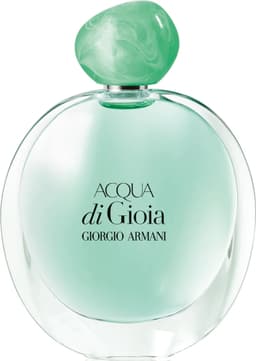
Giorgio Armani launched Acqua di Gioia in June 2010, a women’s eau de parfum signed by Anne Flipo, Dominique Ropion and Loc Dong, inspired by his stays on Pantelleria and Antigua. The house describes it today through crushed mint, primofiore lemon from Calabria, a water jasmine and a base of cedar, labdanum and brown sugar.
Armani describes Acqua di Gioia in three stages. At the top, crushed mint leaves meet a zest of “Limone Primo Fiore Femminello” lemon, harvested during the first blossoms in Calabria, for a freshness the house wants to be exhilarating from the very first green notes.
A water jasmine
The heart rests on a water jasmine. According to Armani, it gives the fragrance aquatic, sophisticated and unexpected facets, and turns the momentum of the opening notes into a feeling of rebirth, amid a delicate, crystalline nature.
Cedar, labdanum and brown sugar
In the base, cedarwood sprinkled with brown sugar joins labdanum, which the house presents as one of the rare plants to possess animalic notes. Armani sees in it the signature of water drawn from the earth.
The materials at launch
The 2010 announcement listed more materials: mint leaves, primofiore lemon, an aquatic green accord, pink pepper, Sambac jasmine, peony, cedar, labdanum and a brown sugar accord. Pink pepper, peony and the green accord are missing from the house’s current description.
What stays out
The peach, passion fruit, marine note and white musks attributed to the fragrance by older listings appear in no Armani description. The house classifies it sometimes among woody citrus scents, sometimes among fruity florals; Wikiparfum places it among the florals.
What the label declares
The printed list names no essential oil: mint, lemon and jasmine are hidden under the fragrance mention. It includes two UV filters, ethylhexyl salicylate and butyl methoxydibenzoylmethane, which protect the juice from light, as well as a green colorant (CI 61570) and a red one (CI 17200).
It also declares allergens: limonene, linalool, citral and geraniol, often associated with citrus, as well as hydroxycitronellal, cinnamal and eugenol. Finally, it lists methyl-2-octynoate, a green molecule reminiscent of violet leaf.
Similar perfumes
Similar notes and family, from other houses.
- Oui La Vie est BelleLancôme
- Vanilla Candy Rock Sugar 42Kayali
- Rare BeginningsRare Beauty
- La Vie est Belle BlancheLancôme
- Bonbon Spring SummerViktor & Rolf
- Yes I Am GloriousCacharel
- Classique Eau Fraîche AirlinesJean Paul Gaultier
- GalatticoLogos Fragrances
More perfumes from Armani
Also composed by Anne Flipo
- GirlRochas
- Irresistible Nude VelvetGivenchy
- Irrésistible Eau de ToiletteGivenchy
- Trésor Midnight RoseLancôme
Also composed by Dominique Ropion
- MiutineMiu Miu
- Portrait of a LadyFrédéric Malle
- Irrésistible Givenchy Very FloralGivenchy
- Trésor in LoveLancôme