
Berdoues
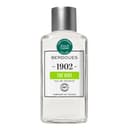
1902 Thé Vert Clean Eau de Cologne
A Toulouse Eau de Cologne that Berdoues keeps in its 1902 collection: lime at the opening, green tea leaf at the heart, musk for the trail. Its Clean version has lost coloring agent and UV filter without changing anything about its character — green, forthright, short, to be sprayed on skin as well as on linen.
Where to buy
It all begins in 1902 in a shop on rue Lafayette, in Toulouse, where Guillaume Berdoues, a barber by trade, composes an amber Eau de Cologne to complete his clients' shave. His son Henri, a chemical engineer, will turn the business into a perfume house and will sign, in the nineteen-thirties, the Violette de Toulouse that made it famous. Four generations on, the company is still family-run and manufactures south of Toulouse. The collection that carries the founding date now brings together some fifteen eaux de Cologne, against about ten less than ten years ago: it is the house's bread and butter, what keeps it running outside of its exceptional perfumes.
The Thé Vert Eau de Cologne belongs to that family of simple freshnesses, sold in large sizes and made to be used freely. It exists as a refillable spray bottle of 125 milliliters and as splash bottles of 245 and 480 milliliters, the latter closer to a bathroom jug than to a perfumery bottle. The detail is not incidental: a cologne of this kind is poured into the palm of the hand, patted on the neck after a shower, sprayed on a shirt or inside a wardrobe, and its price puts it within reach of that gesture.
Green tea entered perfumery in the early 1990s and has never left it, but it most often appears softened — sweetened with fruit, floral with jasmine, extended with milk. Berdoues takes it differently: the dry leaf, the vegetal bitterness, nothing to round off the edges. The collection also includes a Thé Blanc alongside this one, a way of saying that the house treats the leaf as a material in its own right rather than as decoration.
The word Clean attached to the name is not a marketing claim, it denotes a reformulation. The house's eaux de Cologne used to be tinted, and that color had to be protected from light by ultraviolet filters of the benzophenone family; with two of them suspected of acting on the hormonal system, the brand chose to remove the color rather than argue over the filter. The juice is naturally clear, it needed neither the one nor the other. The ingredient lists bear the trace of the shift: yesterday's, still visible at a few retailers, named a yellow colorant, a blue colorant and benzophenone; today's opens on alcohol, water and fragrance, and carries none of them anymore. The formula is stated to be 98% ingredients of natural origin, on a natural alcohol base, and free of animal matter.
It would be wrong to expect from it the longevity of an Eau de Parfum: a cologne of this kind settles in for an hour or two, leaves a green cleanliness and fades away. That is its function. It suits summer best, straight out of the shower or at the end of the day, and it takes very well to being sprayed in excess, which no concentrated perfume forgives. On linen, it lasts longer than on skin.
Olfactory pyramid
Share your impressions
Create an account to keep your votes and find your notebook.