
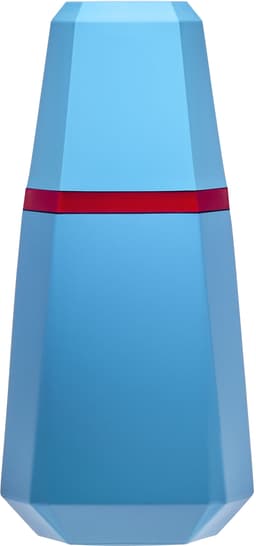
Cacharel's second perfume, Loulou was born in 1987 under the hand of Jean Guichard, nine years after Anaïs Anaïs, whose opposite it takes. Vanilla serves as its foundation, surrounded by sun-kissed, powdery flowers contradicted by a bitter greenness of blackcurrant and tagetes. The juice has divided opinion since its release. Its blue and red bottle, signed by Annegret Beier, borrows its colors from a Matisse odalisque wearing scarlet trousers.
Loulou can be read across seven descriptions that do not copy one another. A fragrance composition house has published its detail, four critics have signed their own, a French institution has evaluated it, a community encyclopedia has compiled it. Twenty-one materials cross the threshold of two witnesses.
Seven sources, and many copies
The lists diverge sharply. The professional note sheet counts twenty-two materials, the community encyclopedia nineteen, the institutional evaluation thirteen, and the four signed reviews name theirs over the course of their analysis, without ever drawing up a table.
Six retail pages reproduce one or another of these lists without changing a word, which creates the illusion of broad agreement where only two sources actually speak. Counting the pages would be misleading.
The opening, the heart and the base
The opening brings together seven materials: plum, blackcurrant, violet, tagetes, anise, bergamot and mandarin. Tagetes, a flower with a bitter and somewhat venomous green facet, gives this fruity opening the strangeness readers speak of most.
The heart counts eight. Tiare flower, ylang-ylang and jasmine provide the sun-kissed share, iris, mimosa and heliotrope the powdery share, orange blossom and tuberose the white amplitude. Tiare flower is cited by five sources out of seven.
The base brings together six. Vanilla, benzoin and incense provide balsamic warmth; sandalwood, tonka bean and musk ensure longevity. They carry the sillage that reviews describe as difficult to contain.
Almond is not a material
Almond recurs in two descriptions without being a material of the perfume. It names a facet of heliotrope, a flower whose powdery odor naturally leans toward almond and toward vanilla. The distinction is worth making.
Vanilla is not an accessory, it is the declared starting point of the composition. Everything else was built around it, which explains why it dominates the base without ever seeming added as an afterthought.
Tuberose presents a curious case. The community encyclopedia does not carry it, yet its own readers point it out in nearly every comment. The professional note sheet and the institutional evaluation do carry it.
What has been set aside
Six materials have only one witness and are excluded: mace, rose, lily of the valley, cedar, vetiver and lily. All exist in the reference database nonetheless, and their absence here rests on the evidence, not on vocabulary.
Cinnamon remains on the edge. The encyclopedia carries it under two names, and readers clearly detect it at the opening, but no second source of a different nature confirms it. It awaits a witness.
A disagreement over tier persists regarding iris. The note sheet places it in the heart position, the encyclopedia splits it between the opening and the heart, one review sends it back to the base. The heart wins out across three sources.