
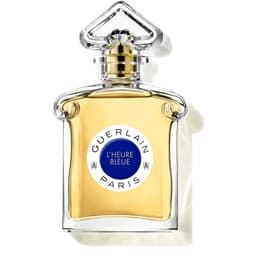
L’Heure Bleue is the eau de parfum that Jacques Guerlain composed in 1912 for Guerlain, a floral amber that the house now sells under the name L’Heure Bleue 1912, in the Les Légendaires collection. Anise and bergamot in the top notes, carnation and neroli in the heart, iris, violet, vanilla, benzoin and tonka bean in the base; inverted heart bottle, 75 ml.
Guerlain now structures L’Heure Bleue 1912 as follows: anise and bergamot in the top notes, carnation and neroli in the heart, iris, violet, vanilla, benzoin and tonka bean in the base. The house describes the base as amber and powdery; the violet accord is a creation of its perfumers, since violet is a mute flower.
Anise and bergamot in the opening
The house speaks of the boldness of the anise note and the freshness of the bergamot. Frolova hears anise as a leitmotif running through the entire fragrance, alongside carnation and ylang-ylang from the opening; Feydeau describes this top accord as bold and delicately fresh.
Carnation and neroli in the heart
The carnation and neroli accord expresses, for Guerlain, a delicate sensuality. Feydeau adds heliotrope, Bulgarian rose and tuberose, a heart she calls spicy, floral and intoxicating; Delacourte cites Bulgarian rose, orange blossom, jasmine, violet and heliotrope.
Iris, violet and vanilla in the base
The base brings together iris, which the house calls the blue gold of perfumery, the violet accord, vanilla, benzoin and tonka bean. Frolova describes velvety layers of iris, vanilla, incense, musk and tonka bean; Delacourte detects a delicious marshmallow and a dominant vanilla.
What remains outside the declared accord
Musk, which Feydeau considers the carnal signature of L’Heure Bleue, does not appear in the accord that Guerlain declares for the 1912 version. Sandalwood, tarragon, clary sage, rose, orange blossom and tuberose, which older lists attributed to it, remain in prose: the house no longer includes them in its pyramid.
Frolova distinguishes between concentrations: the eau de parfum seems to her more velvety and warmer than the eau de toilette, tinged with musk, the extrait even more memorable, a confection of orange blossom, iris and vanilla heightened with licorice. The animalic musk of the old tinctures, Feydeau adds, is missing.
What the label declares
The house publishes for L’Heure Bleue 1912 a coded list, opening with alcohol, the word Parfum and water. Then come linalool and limonene from the citrus, coumarin from the tonka bean, benzyl benzoate and cinnamate, both balsamic, eugenol from the carnation, citronellol and geraniol from the rose.
Alpha-isomethyl ionone carries the violet and iris, hydroxycitronellal a lily-of-the-valley facet, citral the lemony note. Cinnamal, cinnamic alcohol and isoeugenol bring the warm spice; farnesol, benzyl alcohol and benzyl salicylate close the list.