
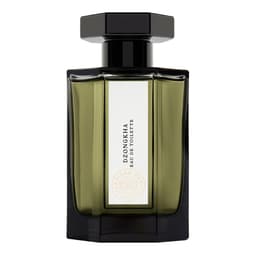
Dzongkha appeared in September 2006. Bertrand Duchaufour wrote the formula for L’Artisan Parfumeur, the third stop in a travel series opened by Bois Farine and Timbuktu. The subject is Bhutan: the stone and incense of the monasteries, worn leather, the smoke of a tea sweetened with spices. Powdery iris holds its base.
Ten materials across three tiers, which the 2006 release copy and Robin’s list sort out between them.
The opening
The start is floral and fruity, peppered with cardamom: the peony and the lychee, which the release copy gives for the freshness of the juice. Robin says she recognises neither of the two, and hears the iris from the first minutes.
The woody heart
The release copy writes a woody heart dominated by vetiver, enriched with a wild tea with milk. Incense and cedar belong there, brought by Robin’s list, which cites them among the announced materials.
The base
Cypriol, the grass from which papyrus is drawn, joins powdery iris and leather. This is the tier everyone hears best: Robin describes it as a velvety, cold iris, a temple stone.
What stays out
One relay names papyrus where the release copy names cypriol: it is the same material, and the wording of the release copy wins. The spices, cited in a block by an aggregator, do not enter the reference list under that name.
What the label declares
Twenty-three entries: denatured alcohol, water, fragrance, an antioxidant, benzoic acid, benzyl alcohol, and a long file of regulated allergens — alpha-isomethyl ionone, hexyl cinnamal, limonene, citronellol, eugenol, geraniol, cinnamal, benzyl benzoate, isoeugenol, linalool, benzyl cinnamate, benzyl salicylate, citral, coumarin, farnesol, amyl cinnamal, anise alcohol. No substance banned in the European Union appears there. The house, Printemps and 24S serve the same one, word for word.