
It was in 1925 that Marcel Rochas decided to create his fashion house, on Rue du Faubourg Saint-Honoré, in Paris. Later, he expanded his business and brought in the world of perfumery. Nevertheless, upon the death of Marcel Rochas, in 1955, it was his wife, Hélène, who took over the leadership of the company.
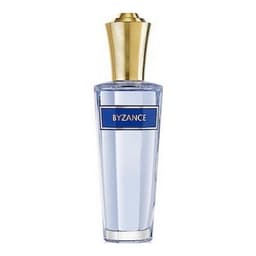
The story of Byzance begins in 1987. Naturally, this fragrance conveys the opulence of its name, Byzance. Strong in character, Byzance draws inspiration from Byzantine art. It should be noted that Byzantium is the name of an ancient Greek city located at the entrance to the Bosphorus. Byzantium later became the capital of the Ottoman Empire. Byzance draws directly on the mosaics of Ravenna, those that make up the San Vitale basilica, which Nicolas Mamounas visited during a stay in Italy. Byzance is a fragrance that calls for travel and for a coming together of East and West. The original composition was revisited in 2017.
Nicolas Mamounas's inspiration for Byzance by Rochas
To turn Rochas into a major perfume house, Hélène Rochas, then at the head of the house of Rochas, decided to call on the greatest perfumers of the time. After Guy Robert and Edmond Roudnitska, it was Nicolas Mamounas who took charge of imagining olfactory creations. He was Rochas's perfumer from 1970 to 1987. From the moment he arrived, he made his mark by creating the wonderful Eau de Rochas. Nicolas Mamounas is also responsible for other fine fragrances, mainly within the house of Rochas, such as Lumière, Mystère and Macassar.
Byzance and its undeniable character
Make no mistake, Byzance has character and asserts it loudly. Steeped in sunshine, the composition of Byzance contains mainly Mediterranean ingredients. Byzance opens on a trio of bright, citrus notes, namely citron and mandarin paired with cardamom. The heart of Byzance is floral, composed of jasmine and Turkish rose. Turkish rose, also called Damanesca rose, accounts for 95% of the rose essences and absolutes used in perfumery. Damanesca rose is grown in Bulgaria in a region now known as the Valley of the Roses. The scent of this rose is radiant, both floral and fruity, and Turkish rose also gives off notes reminiscent of sake, a rice-based alcohol. Damanesca rose is highly prized by perfumers, as it is considered a noble, ultra-feminine flower. Finally, the base of Byzance is sensual and powerful, combining amber, patchouli, amber, musk and vanilla, which lends an oriental character to the whole composition.
Byzance draws inspiration from Byzantine art, but also carries with it an entire history. Thanks to its strong character, Byzance is a fragrance that stands out while remaining feminine and sensual. The composition, signed by Nicolas Mamounas, brings together quality ingredients, chiefly Damanesca rose.