
Her Parfum
Burberry Her Parfum: liquid London, or how to distill the energy of a capital city into a fruity gourmand How does one capture the essence of a world city in eighty milliliters of scented alcohol? How does one translate olfactorily the chaotic and fascinating energy of a megalopolis of nine million inhabitants that pulses to the rhythm of red double-decker buses, green parks crossed by bicycle, free museums crowded on Sunday afternoons, Camden markets buzzing with every language of the Commonwealth, and that British youth who navigate with disconcerting ease between scrupulous respect for tradition (tea time at 4pm, disciplined queuing at bus stops) and the unbridled avant-gardism of Shoreditch clubs where techno resonates until dawn?
Where to buy
This is precisely the vertiginous challenge that Francis Kurkdjian – a French perfumer based in Paris, therefore outside the London culture he had to capture – was given in 2018 when Burberry asked him to create Her, a manifesto fragrance meant to embody the new olfactory identity of the British house for a generation of women born in the 1990s and 2000s who knew neither the Cold War nor the analog era, but who grew up with Instagram, Brexit, and an acute awareness that British identity itself is in perpetual redefinition – both insular and globalized, deeply rooted in its colonial past while being fiercely multicultural, obsessed with social class while celebrating meritocratic ascension.
The French gaze on Britishness: interview with Kurkdjian on the creation of Her
In an interview given to Canadian journalist Dave Lackie at the launch of Burberry Her, Francis Kurkdjian offers a fascinating reflection on his working method when it comes to capturing the olfactory identity of a place he does not know intimately: As a Frenchman, how did you create the English note of Her?, the interviewer asked him. Kurkdjian's response: By capturing the energy, the carefree spirit, the sparse parks of the city, the style of women in the street... And what does London smell like then? English perfumery, marked by the barbershops of old.
This answer reveals a sophisticated methodological approach: Kurkdjian does not seek to create a fragrance that smells like London actually smells (what would that even mean? The smell of the London Underground at Piccadilly Circus? The misty Thames at Greenwich? The greasy fish and chips from a neighborhood pub?), but rather to create a fragrance that evokes the impression, the atmosphere, the energy one feels while walking through London – that contradictory blend of dynamism and nonchalance, that ability Londoners have to run frantically toward their destination while giving the impression they have nowhere to go.
The reference to English perfumery marked by the barbershops of old is particularly revealing: Kurkdjian is referring to that historic British olfactory tradition – the fresh, citrusy colognes of Victorian gentlemen, shaving soaps scented with lavender, vetiver, sandalwood, all that masculine-unisex perfumery inherited from the imperial era when smelling good meant smelling clean in an aromatic-woody register rather than a floral-powdery one. Houses like Penhaligon's (founded 1870), Floris (founded 1730), or Truefitt & Hill (founded 1805) still embody today this English olfactory heritage made of civilized freshness, elegant woods, and a nearly puritanical restraint that considers overly demonstrative fragrances a matter of continental bad taste.
The creative oxymoron: how to create an English fragrance that does not smell English
But here lies the paradoxical genius of the brief given to Kurkdjian: to create a fragrance that evokes London while completely breaking with this classic English olfactory tradition. Her does not smell at all of Victorian lavender or the sandalwood of Mayfair gentlemen's clubs. On the contrary, Her explodes into a fruity-gourmand detonation of crushed strawberries, candied raspberries, juicy blackberries – an aromatic universe that English perfume purists would probably have called frightfully vulgar as recently as fifty years ago.
This deliberate break with the historic British olfactory canon reflects a profound sociological transformation: contemporary London is no longer the imperial capital of Edward VII sipping tea in the parlor in a three-piece suit, it is a cosmopolitan megacity where a Generation Z born to Indian, Jamaican, Polish, Nigerian immigrant parents listens to British grime (Stormzy, Skepta) while eating Nepalese momos at Brixton Market before dancing to house music at Fabric. This London can no longer be captured by lavender and vetiver – it demands fragrances as hybrid, as globalized, as joyfully unselfconscious as the city itself.
Her thus embodies this fascinating creative tension: it is an English fragrance in concept (it represents Burberry, the quintessential English house) but international-gourmand in its olfactory execution (it could be worn by a New Yorker, a Parisian, a Tokyoite without anyone thinking, here is a typically English fragrance). This assumed universality is precisely what makes Her contemporary: in an era of accelerated cultural globalization, the national identity of a fragrance resides less in its olfactory notes (which circulate everywhere) than in its storytelling and packaging (hence the crucial importance of the check motif on the bottle, which will be discussed later).
The sparse parks and London's carefree spirit: translating an ambiance into molecules
Kurkdjian mentions having captured the carefree spirit and the sparse parks of London. This reference to parks is far from anecdotal: London has a unique relationship with its green spaces, which occupy nearly 40% of its total area – urban lungs like Hyde Park (142 hectares), Regent's Park (166 hectares), or Hampstead Heath (320 hectares) that allow Londoners this characteristic practice of park lounging: sprawling on the grass (as soon as the thermometer exceeds 15°C, which already constitutes a notable climatic event in London), picnicking, reading, sunbathing with more or less success depending on the precarious sunshine.
How does one translate olfactorily this London park atmosphere? Not through classic green notes (violet leaf, galbanum, cut grass) that would evoke a very French garden, but rather through a certain airy lightness in the composition, the impression that one can breathe amply, that the fragrance does not saturate the space but crosses it like a breeze – exactly like those June afternoons at Regent's Park when the wind makes the branches of weeping willows dance. The sparkling top notes (citrus, tart red fruits) create this respiratory opening effect, while the base remains deliberately discreet to avoid any heaviness that would contradict the idea of carefree ease.
The carefree spirit itself – that studied nonchalance, that British-casual cool that allows a Londoner to wear simultaneously a vintage Burberry trench inherited from her grandmother, worn Converse sneakers, and a Mulberry bag without the whole thing seeming either overdressed or sloppy – translates olfactorily into a refusal of intimidating sophistication. Her is not a fragrance that impresses through its complexity (unlike a Guerlain chypre where one can identify fifteen intertwining notes), it is a fragrance that seduces through its immediate obviousness: it smells good of sweet red fruits, period. This apparent simplicity (deceptive, since the formula is actually very elaborate) allows the fragrance to be worn effortlessly, without reflection, exactly as a Londoner slips on her leather biker jacket without wondering whether it is appropriate – of course it is, since she decided it is.
From gabardine to bottle: one hundred sixty-five years of trajectory of a textile house turned olfactory empire
To understand what Burberry Her represents in the history of the house, one must first retrace Burberry's extraordinary trajectory from its founding in 1856 to its current status as a global luxury giant worth several billion pounds sterling. This company, born to equip Victorian explorers with waterproof clothing, transformed into a laboratory of globalized British identity – a transformation that was neither obvious nor linear, and that required several painful reinventions to avoid sinking into datedness or has-been status.
1856-1879: Thomas Burberry and the invention that changed outerwear forever
The story begins banally: in 1856, Thomas Burberry, a twenty-one-year-old young man who had completed his apprenticeship with a draper, opened his own outdoor clothing shop in Basingstoke, a small town in Hampshire located eighty kilometers southwest of London. The initial concept had nothing revolutionary about it: to sell practical and durable clothing capable of protecting against the notoriously rainy and windy British climate. For twenty-three years, Burberry perfected his craft as an artisan-merchant with no sign foreshadowing the extraordinary destiny of his company.
Then came 1879 – the year that changed everything. Thomas Burberry invented (or rather perfected, since the principle already partly existed) gabardine: a revolutionary fabric obtained through tight weaving of cotton threads treated in bulk before weaving rather than after, thereby creating a textile that was simultaneously waterproof, breathable, and tear-resistant. This triple technical miracle – waterproofness plus breathability plus durability – solved a problem that had haunted clothing for centuries: how to stay dry in the rain without cooking in one's own sweat inside the waterproof garment?
The existing solutions were all unsatisfactory: vulcanized rubber Macintosh capes (invented 1823) certainly kept you dry but turned you into a walking sauna; thick woolens like tweed absorbed moisture and became heavy as lead once wet; oiled waxes used by sailors were effective but stiff and foul-smelling. Burberry gabardine finally offered the magic equation: a light, supple fabric, pleasant to the touch, that let the body's water vapor escape while preventing raindrops from penetrating. The patent was filed in 1888, and Burberry's fortune was made.
1902-1918: From the battlefield to the civilian wardrobe, the birth of the trench coat
In 1902, Burberry adapted its gabardine to create the Tielocken – direct ancestor of the trench coat – for British army officers. When the First World War broke out in 1914, the British High Command ordered this functional coat en masse, every detail of which met a precise military need: epaulettes to indicate rank, D-rings on the belt to hang equipment (grenades, lamp, canteen), a storm flap protecting from rain (gun flap, originally to protect the rifle), a storm shield on the right shoulder (to deflect wind and rain), a back vent (to facilitate movement), a tied belt (to retain warmth).
This coat designed for trench warfare (hence its name: trench) would acquire an unexpected double legacy. First, military-historical: it is the coat worn by hundreds of thousands of British officers in the muddy hell of the Somme, Passchendaele, Ypres – it is therefore laden with the entire collective memory of the Great War, a founding conflict that killed 900,000 British soldiers and left lasting trauma on society. Then civilian-glamorous: after 1918, demobilized officers continued to wear their trench coats in everyday life, and the garment gradually moved from the military wardrobe to the elegant civilian wardrobe.
Hollywood would complete this symbolic transmutation by making the trench coat the iconic costume of private detectives (Humphrey Bogart in The Maltese Falcon 1941, Casablanca 1942), spies (That Man from Rio 1964), and investigative journalists (All the President's Men 1976). The trench thus became the uniform of the modern hero – neither military nor civilian, neither working-class nor aristocratic, but a man (then a woman) of action operating in the gray zones of contemporary urban society. This ambiguous status of the trench – simultaneously a banal rain garment and a cinematic icon charged with coolness – would become Burberry's semiotic trademark: objects that oscillate between the functional-ordinary and the mythical-desirable.
1920s: Invention of the Burberry Check, a marketing accident turned worldwide signature
In the 1920s, Burberry introduced what would become the most recognizable graphic element of its visual identity: the check motif composed of interlocking beige/camel, black, red, and white lines creating a stylized tartan. Initially, this motif was only meant to serve as an internal lining for trench coats – a detail invisible from the outside, serving solely as a discreet signature for insiders (when one opened one's trench, the check lining immediately signaled this is a Burberry).
But in the 1960s, a buyer at the Burberry boutique in Paris, Jacqueline Dillemman, had the brilliant idea of cutting out the check lining of a trench and using it to cover her umbrellas and luggage – thus transforming a hidden element into an external visual statement. Burberry immediately understood the commercial potential and began producing accessories displaying the check on the outside: scarves (the check scarf created in 1967 quickly became a bestseller), umbrellas, bags, caps. The motif became so popular that it partly escaped the brand's control: in the 1990s and 2000s, the Burberry check was massively counterfeited and worn by populations that did not correspond at all to the brand's luxury positioning.
In England in particular, the Burberry check became associated with chav culture – a pejorative term designating an urban working-class subculture characterized by the ostentatious wearing of luxury brands (often counterfeit), public drinking, and an aggressive-flashy style. Third-division footballers, reality TV celebrities, suburban teenagers wore the Burberry check from cap to socks by way of tracksuit – a saturation that completely devalued the brand's prestige. In the early 2000s, some London pubs and nightclubs went so far as to refuse entry to people wearing Burberry check items, so much had the motif become synonymous with aggressive laddishness.
2001-2018: Christopher Bailey and Burberry's digital-heritage reinvention
Faced with this catastrophic image crisis, Burberry undertook a radical reinvention in the early 2000s under the creative direction of Christopher Bailey (creative director from 2001 to 2018, CEO from 2014 to 2017). The Bailey strategy rested on three pillars: first, drastically reducing the presence of the check in collections (it went from an omnipresent motif to a discreet accent); second, reaffirming Burberry's heritage around the trench coat and upscale British legacy; third, making Burberry a pioneering brand in the digitalization of luxury.
It was under Bailey that Burberry became in 2010 the first luxury house to fully livestream its runway shows on the internet – allowing the entire world to watch in real time the London shows previously reserved for a few hundred privileged guests. Burberry invested massively in social media, created interactive digital experiences, developed innovative mobile applications (such as Burberry Acoustic, which promotes young British musicians), and transformed its stores into retail theaters where technology enhances the shopping experience. This digital vanguard allowed Burberry to radically rejuvenate its image and attract a connected millennial clientele who saw in the brand no longer the dated symbol of the British establishment but a cool, modern, dynamic brand.
In 2018, a new turning point: Christopher Bailey left Burberry and was replaced by Riccardo Tisci as creative director. Tisci (Italian, ex-Givenchy) was tasked with further radicalizing Burberry's modernization. He commissioned graphic designer Peter Saville to create a new logo – abandoning the word BURBERRY in tight capitals in favor of a TB (Thomas Burberry) monogram interlaced within a circle, more minimalist and modern. It is this new logo that appeared for the first time on the packaging of Burberry Her in October 2018 – the fragrance thus became the olfactory standard-bearer of the new Burberry visual identity of the Tisci era.
Bold strawberry and addictive musk: dissecting the gourmand alchemy signed Kurkdjian
Let us now move from marketing storytelling to molecular reality: what exactly does this pale pink bottle contain, whose commercial success has been such that it spawned, within five years, an entire lineage of flankers (Her Intense 2019, Her London Dream 2019, Her Blossom 2019, Her Petals 2020, Her Elixir 2023)? The announced olfactory pyramid multiplies fruity notes at the opening – a typical strategy of contemporary gourmands that bets on immediate impact, instant appeal, the olfactory love-at-first-sight from the very first second.
Calibrated fruity explosion: strawberry, raspberry, blackberry, cherry, blackcurrant – why so many berries?
Her opens on a veritable salvo of red fruits: strawberry, raspberry, blackberry, sour cherry, blackcurrant, accompanied by mandarin and lemon. Seven top notes out of fourteen total notes – that is, half the pyramid concentrated in the first fifteen minutes! This overrepresentation of red fruits is obviously not accidental: it responds to an implacable commercial logic that dictates that mass-market fragrances must hook the tester's nose immediately in store. There are only a few seconds to convince – no time to develop a subtle complexity that only reveals itself after twenty minutes of drydown.
But why specifically red fruits rather than other fruits? Because berries possess an aromatic profile that combines three commercially desirable qualities: sweet gourmand character (which appeals universally), sparkling acidity (which avoids cloying), and a certain perceived sophistication (berries are expensive at the market, hence they connote food luxury – unlike bananas or apples, everyday fruits). Moreover, red fruits evoke childhood, homemade jam, grandmother's garden, British summer pudding – an entire comforting and nostalgic imaginary that activates the brain regions associated with happy memories.
Chemically, this fruity explosion is of course entirely reconstructed synthetically. Strawberry is obtained via furaneol (also called strawberry furanone, a molecule that smells intensely of ripe strawberry with a slightly caramelized facet) and ethyl maltol (a molecule that smells of cooked sugar, cotton candy, and that amplifies all gourmand notes). Raspberry draws on raspberry ketone (frambinone), which has that magical quality of smelling simultaneously of fresh fruit and raspberry candy. Blackberry and black cherry use esters that mimic the tart-sweet juiciness of wild berries. Blackcurrant calls upon sulfured thiols that give that characteristic cat pee note (in minimal concentration it smells fruity-green-alive rather than unpleasant).
The discreet floral duo: powdery violet and radiant jasmine deliberately held back
After the fruity onslaught of the opening, Her transitions to a remarkably sober floral heart: only two flowers listed – violet and jasmine. This economy of means contrasts strongly with classic white florals that stack jasmine plus tuberose plus orange blossom plus gardenia plus ylang-ylang in a demonstrative bouquet. Here, Kurkdjian practices restraint: the flowers are not there to assert themselves but to moderate, soften, and slightly sophisticate the initial fruity acidity without ever dominating it.
Violet brings its characteristic powdery-sweet signature. In modern perfumery, violet is mainly reconstructed with ionones (alpha and beta) – molecules discovered in the 19th century that smell of powdery-fresh violet with woody-floral facets. Ionones have this fascinating peculiarity of rapidly saturating olfactory receptors: after a few minutes of exposure, our nose temporarily stops perceiving them (olfactory fatigue phenomenon). This is why violet in Her seems to disappear and then reappear intermittently – one smells it, then it fades, then one finds it again a few minutes later.
This powdery violet dialogues with jasmine, which brings its floral luminosity without ever tipping into the indolic-animalic. The jasmine used here is clearly a clean jasmine, built around hedione (a Firmenich molecule that smells of airy-transparent jasmine) rather than around natural jasmine absolute, whose fecal-animalic facets would have contradicted the fragrance's young-fresh-carefree positioning. This radiant jasmine creates a halo of floral femininity around the fruits without ever smothering them – it stays in the background, a discreet servant rather than an omnipresent star.
The addictive foundation: sensual musk, creamy vanilla, and the enigmatic cashmeran
The base of Her rests on the now-unavoidable triptych of every mass-market commercial gourmand: musk plus vanilla plus woody note, here supplemented by a few complementary ingredients (amber, oakmoss, patchouli). But the star ingredient, the one that makes all the difference and largely explains the fragrance's commercial success, is cashmeran – a synthetic molecule created by the IFF laboratory that deserves particular attention, as it embodies modern perfumery.
Cashmeran (also marketed under the name synthetic cashmere) is a wonderful molecule that smells simultaneously woody-amber, musky-velvety, with slightly spicy-vanilla facets and an olfactory texture of almost supernatural softness – exactly as its name indicates: the olfactory sensation of cashmere, that ultra-fine wool that caresses the skin. Chemically, it is a dihydronaphthalene musk, but the formula matters little – what matters is the effect: cashmeran wraps all the other notes in a soft cocoon, it softens the edges, it unifies the composition, it creates that impression of immediate olfactory comfort that means one never wants to wash the wrist on which the fragrance was sprayed.
This cashmeran is the secret ingredient that transforms Her from a banal fruity gourmand into an addictive fruity gourmand. It is what creates what Francis Kurkdjian himself describes as the unconventional character of the fragrance: Burberry Her, as a gourmand, departs from the traditional gourmand family because it is neither sticky nor thick. On the contrary, it is airy and light in a unique way. This paradoxical lightness (how can a fragrance be both gourmand-sweet AND airy-light?) comes precisely from the cashmeran, which lightens the texture without reducing the gourmand character – it creates a silk gourmand rather than a thick honey gourmand.
The musks (probably a blend of modern polycyclic musks such as Galaxolide) amplify this addictive softness sensation by adding their own clean-skin signature, while the vanilla (synthetic ethylvanillin) brings just enough sweet-creaminess without ever tipping into cloying pastry territory. Patchouli and oakmoss (probably reconstructed synthetically since natural oakmoss is now heavily restricted by European IFRA regulation) add an earthy-woody depth that anchors the whole and prevents the fragrance from becoming too sweet-fruity-one-dimensional.
The Baccarat Rouge 540 debate: filiation or coincidence?
A recurring debate among perfume aficionados concerns the presumed kinship between Burberry Her and Baccarat Rouge 540 – an iconic fragrance also created by Francis Kurkdjian for his own house Maison Francis Kurkdjian in 2015. Several testers swear they perceive a striking similarity, particularly in the drydown, where Her develops amber-woody-sweet facets reminiscent of BR540's characteristic sillage. Others consider this comparison absurd, arguing that the two fragrances simply share certain widely used modern ingredients (ambroxan, cashmeran, hedione) without fundamentally resembling one another.
The truth probably lies somewhere in between: Francis Kurkdjian possesses what one might call a molecular signature – a set of ingredients and accords he particularly favors and that can be found in many of his creations. The generous use of cashmeran, the presence of ambroxan (an ultra-powerful amber molecule that smells simultaneously mineral, amber-sweet, with an almost salty facet), the construction around very clean modern musks – all these elements do indeed create an olfactory kinship between Her and BR540, even though the two fragrances remain clearly distinct (BR540 is much more abstract-mineral where Her is clearly fruity-gourmand).
This Kurkdjian signature partly explains, moreover, the commercial success of Her: the fragrance offers an accessible version (around €80-100) of an olfactory style close to BR540 (which costs €250-300 per bottle). For consumers who find BR540 either too expensive or too bold, Her offers a softer, more reassuring, more explicitly feminine-gourmand alternative while retaining something of the luminous modernity that characterizes Kurkdjian's work.
The check bottle: visually translating one hundred sixty-five years of textile DNA into a vanity-table jewel object
If Burberry Her met with such commercial success (to the point of becoming one of the best-selling women's fragrances in the United Kingdom in the years following its launch), it is as much thanks to its juice as to its packaging, which achieves the feat of visually condensing the entire Burberry identity into an eight-centimeter-tall object. The bottle does not merely contain the fragrance – it IS the fragrance, in the sense that it is what is displayed on the vanity table, photographed for Instagram, given as a gift in its beige cardboard box stamped with the TB logo.
Anatomy of the bottle: between perfumery classicism and textile innovation
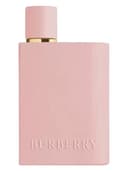
The shape of the bottle takes up the classic silhouette of upscale women's perfume bottles: a rectangular body with slightly rounded angles, vaguely evoking a small precious ingot, topped with a square glossy black bakelite cap. Nothing revolutionary in this geometry – it follows the expected visual codes of luxury women's perfumery, somewhere between minimalist sobriety (Chanel-type) and precious jewel (Lancôme-type). The glass itself is tinted in a translucent pale pink that lets the amber liquid inside show through – a color that evokes simultaneously soft femininity, English rose petals, and that pastel-millennial Instagram aesthetic that dominated the late 2010s.
But the real innovation, the element that transforms this generic bottle into an object immediately identifiable as Burberry, is the treatment of the bottle body: the glass is quilted with a geometric pattern that exactly reproduces the weave of the Burberry check. This is not a simple label stuck onto the bottle, but a relief of ridges and grooves molded directly into the glass, creating a play of shadow and light that visually traces the horizontal and vertical lines of the check even in the absence of distinct colors. It is a technical feat of glass molding (a complex and costly process) that transforms a two-dimensional textile pattern into a three-dimensional tactile sculpture.
This check relief fulfills several semiotic functions simultaneously: first, it visually anchors the bottle within the Burberry universe (anyone who knows the brand immediately recognizes the check); then, it creates an additional tactile dimension (when one holds the bottle, one physically feels the relief of the weave under one's fingers); finally, it establishes a poetic bridge between textile and liquid, between Burberry's original trade (making fabrics) and its perfume activity (creating scents) – as if the fragrance were liquefied fabric, or conversely as if the fabric were solidified fragrance.
The beige ribbon: textile signature turned seal of authenticity
Around the neck of the bottle, just under the black cap, is tied a beige fabric ribbon with satin sheen – a small detail that might seem purely decorative but that actually fulfills a crucial semiotic function. This beige ribbon refers directly to the iconic Burberry color (that beige-camel that constitutes the background color of the check pattern), and its textile materiality explicitly recalls that Burberry is first and foremost a fashion house, not a perfume house. The fragrance thus presents itself as a satellite of the fashion activity rather than as an autonomous entity – a clever strategy that allows the brand to capitalize on the fame and prestige of Burberry fashion.
This ribbon also functions as a visual seal of authenticity: its presence immediately signals that this is an authentic Burberry bottle rather than a counterfeit (even though sophisticated counterfeiters also reproduce this detail). In the visual economy of Instagram, where perfume bottles have become lifestyle staging accessories photographed ad nauseam, this small beige ribbon carries a signal value disproportionate to its size: it allows the fragrance to be instantly identified even in a blurry photo taken from afar, thus creating a form of organic advertising every time a user posts a photo of her shelfie (a neologism referring to photos of bathroom or vanity table shelves displaying one's collection of cosmetics and fragrances).
The complete packaging: beige box and iconic shopping bag
The bottle itself represents only half of the packaging experience – the other half lies in its case: a rigid cardboard box in signature Burberry beige, stamped with the new TB (Thomas Burberry) logo redesigned by Peter Saville in 2018. This uniform beige box, almost austere in its monochrome sobriety, deliberately contrasts with the packaging of mass-market women's fragrances, which generally multiply bright colors, floral patterns, and gold or silver metallic finishes. Burberry makes the opposite choice here: packaging that evokes discreet luxury, phlegmatic British elegance, that restraint which considers ostentation vulgar.
But Burberry's true marketing masterstroke lies in the shopping bag that accompanies in-store purchases: this beige/camel bag printed with the check motif over its entire surface has become an object of desire in its own right, to the point that some people buy Burberry products mainly to obtain the matching bag. In the London Underground, seeing someone carrying a Burberry shopping bag immediately signals I am coming back from shopping at a luxury store – the bag becomes a visible social marker, a form of symbolic capital proudly displayed for the few hours or days following the purchase before it ends up folded at the back of a closet.
This transformation of packaging into an autonomous object of desire represents an ultimate culmination of contemporary marketing logic: one no longer buys merely a product (the fragrance) but an entire experience (the bottle plus the box plus the bag plus the possibility of photographing it all for Instagram plus the feeling of belonging to the Burberry tribe). The fragrance thus becomes less an olfactory substance than an identity totem, a badge of affiliation worn to signal one's belonging to a certain aspirational lifestyle – urban, London-based, young, trendy but not too much, a touch rebellious but always chic.
Today's Londoners: kaleidoscopic portraits of an urban femininity in perpetual motion
Who is Burberry Her aimed at? The official marketing answer would be: at women embodying the spirit of London – but this hollow formula does not tell us much. To truly understand the fragrance's target, one must examine the casting of the advertising campaign orchestrated by Burberry: Cara Delevingne as the main face of the campaign, accompanied by a group of ethnically diverse young women photographed in iconic London locations (Tower Bridge, red telephone boxes, cobblestone streets). Cara herself perfectly embodies the ambiguity of contemporary British class: from an aristocratic background (her family associates with the royal family), yet she cultivates a rebellious-offbeat image (thick eyebrows embraced against dominant beauty codes, openly bisexual, humor on social media).
The multicultural urban millennial: London as identity laboratory
The first profile targeted by Her is that woman born between 1990 and 2000 (therefore between twenty-three and thirty-three years old in 2023), who grew up in a multicultural urban environment where traditional British identity (white, Anglican, upper middle class) represents only one option among others. In London particularly, the demographic statistics are striking: according to the 2021 census, only 37% of London's population identifies as White British – in other words, nearly two out of three Londoners are either non-white or white but of foreign origin (Eastern Europeans, Australians, South Africans, etc.).
This generation grew up with a fluid and hybrid conception of identity: one can be British AND Nigerian, wear a sari to a wedding AND Dr. Martens the next day, listen to London grime AND Bollywood, eat fish and chips on Friday AND jollof rice on Saturday. Her addresses these women who navigate with ease between several cultural codes without ever feeling obliged to choose a side. The fragrance itself reflects this hybridity: it is British by its brand and its storytelling, but international-universal in its fruity-gourmand olfactory style, which could just as easily appeal to a New Yorker as to a Tokyoite.
The creative-digital working girl: from Shoreditch to Soho, a professional cartography
The second important profile is that of the London creative professional working in creative or digital industries – marketing, communications, design, fashion, media, tech startups. London hosts professional clusters that are very geographically defined: Shoreditch and Hackney to the east for tech startups and graphic design studios, Soho in the center for advertising agencies and audiovisual production houses, Clerkenwell for architecture and interior design. These neighborhoods have seen the emergence of an entire economy of freelancers and innovative small businesses where dress codes are much more casual than in the traditional financial City.
For these women, Her represents the ideal fragrance for daily professional life: sophisticated enough to be worn at the office without being too much (unlike a heady oriental that would be unsuitable for an open-plan office), distinctive enough not to blend into olfactory anonymity (unlike a generic cologne), modern and young enough to correspond to the image they want to project (creative, dynamic, trendy but not fashion victims). The fragrance thus becomes an element of personal branding, in the same way as the MacBook Air placed on the table of the trendy coffee shop in Shoreditch or the canvas tote bag printed with an ironic slogan.
The intergenerational gift recipient: when mom gives Burberry to her daughter
The third crucial segment for Her's sales is that of intergenerational gifts – notably mothers in their forties and fifties who give the fragrance to their teenage or young adult daughters. Burberry occupies an ideal position here: it is a brand that the parental generation knows and respects (therefore reassuring to give as a gift), but one that has managed to modernize enough not to seem dated to the generation receiving it. A mother can buy Her for her eighteen-year-old daughter's birthday without fearing that the latter will roll her eyes and sigh oh mom, really, Burberry, so has-been...
This gift dimension also explains the launch timing (October 2018, therefore just before Christmas) and the available sizes (30ml, 50ml, 100ml, allowing adaptation to all budgets). The fragrance thus becomes a rite of passage: the first real eau de parfum given to a teenager who abandons the fruity-sweet eaux de toilette of her childhood to enter the more sophisticated world of adult perfumery. Her, with its accessible red fruits and its consensual musky base, is the perfect candidate for this transition: it remains young-fruity enough not to seem too aging, but it has enough longevity and complexity to be perceived as a real fragrance rather than a teenager's body spray.
Performance and occasions of wear: from daily life to festive occasions
In terms of olfactory performance, Her sits in a satisfying middle zone without being exceptional. Longevity oscillates between six and eight hours on skin according to testers – decent for a contemporary eau de parfum but without reaching the peaks of persistence of certain tenacious orientals or ultra-concentrated gourmands. Projection remains moderate: within a radius of about one meter during the first two hours, then it becomes more intimate, almost a skin scent. This relative discretion is consistent with the fragrance's positioning: it is a fragrance for oneself and one's immediate surroundings rather than a fragrance meant to mark an entire public space with its sillage.
This moderate performance makes it an excellent candidate for daily wear – office, university classes, shopping with friends, Sunday brunch. It also works very well for slightly dressier but non-formal occasions: dinner at a restaurant, a night at the movies, an opening at a Shoreditch art gallery. On the other hand, for a gala evening or a wedding, some will prefer to opt for something more assertive, more projected, more olfactorily dressed up – Her Intense (a more concentrated flanker released in 2019) precisely fulfills this function of offering an amplified version for big occasions.
A transatlantic olfactory work that distills London's chaotic energy into an accessible fruity gourmand, Burberry Her succeeds at the difficult challenge of embodying a British identity in full mutation – neither the imperial perfidious Albion nor the Cool Britannia of the 1990s, but a liquid, hybrid, multicultural, digital Britishness that joyfully embraces its contradictions. By marrying crushed strawberries and addictive musk, powdery violet and velvety cashmeran on a quilted bottle that transforms the textile check into a glass sculpture, Francis Kurkdjian creates less a fragrance than a cultural object that materializes this precise moment in post-Brexit London history when British identity feverishly questions what it has become while resolutely charging toward an uncertain future. Her thus smells of what is most contemporary about London: that capacity to be simultaneously deeply rooted in its centuries-old history (gabardine, trench, check) and resolutely turned toward a cosmopolitan future where nationality becomes almost anecdotal in the face of belonging to a globalized creative class that speaks English, wears the same sneakers, posts on the same social networks, and smells – precisely – of the same fruity-musky fragrance regardless of the continent it finds itself on.
Olfactory pyramid
Share your impressions
Create an account to keep your votes and find your notebook.