
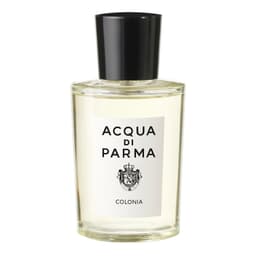
Colonia is the eau de Cologne that founded Acqua di Parma in 1916 and remains the house's emblematic fragrance. This citrus classic opens on lemon, sweet orange and Calabrian bergamot, moves through an aromatic heart of lavender, Bulgarian rose, verbena and rosemary, and settles on vetiver, sandalwood and patchouli.
Critics hold Colonia to be a model. Trine Mork, on the blog Scent Gourmand, sees it as the prototype of the citrus Cologne, which she respects without adopting it; Varanis Ridari, on The Scented Devil, makes it the template for Mediterranean Colognes with aromatic herbs.
Olfastory’s review
Two signed reviews recognize Colonia as a model of its kind, without concealing its limitations.
The prototype of the citrus Cologne
Trine Mork, who runs the blog Scent Gourmand, reviewed it in August 2021. She describes a lively opening of citrus and verbena, a rose heart that briefly pulls the fragrance toward floral chypre before vetiver brings it back, and names this passage her favorite moment.
She regrets a soapy, musky finish, a longevity of only a few hours, and reserves it for daytime wear, especially in summer. She nonetheless holds it to be the prototype of the citrus Cologne, a masterpiece that deserves respect.
The template for Mediterranean Colognes
Varanis Ridari, on his blog The Scented Devil, sees Colonia as the model for Mediterranean Colognes with aromatic herbs, which other Italian houses have taken up and extended, such as Acqua di Selva in 1949.