
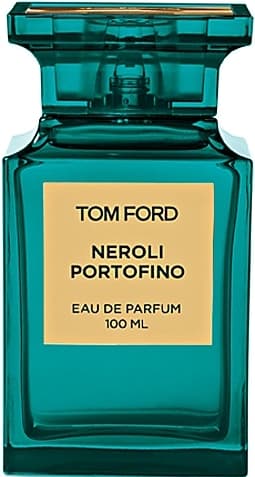
Neroli Portofino is the unisex eau de parfum Rodrigo Flores-Roux composed in 2007 for Tom Ford’s Private Blend collection. The house sees it as a new reading of the Italian eau de cologne: bergamot, mandarin and lemon, Tunisian neroli, orange blossom and lavender, amber and rosemary. Dressed in turquoise since 2011, it has given its name to an entire collection.
The house breaks Neroli Portofino down into three tiers: Italian bergamot, winter yellow mandarin and Sicilian lemon at the top; Tunisian neroli, orange blossom and lavender in the heart; amber and rosemary in the base. Its French text sets the sparkling neroli against the softer lavender, warmed by amber.
Italian citrus at the top
Bergamot, mandarin and lemon open the fragrance for the house, and Wikiparfum counts them among its materials. Victoria Frolova first smells an aromatic accord of herbes de Provence, lavender, thyme and rosemary, which the bergamot makes exhilarating, over a cool, crisp character.
Neroli, orange blossom and lavender in the heart
Tunisian neroli and orange blossom form the floral heart, which the lavender pulls toward the aromatic. Frolova finds a green, soft and silky layer there; the house speaks of neroli as a tonic, luminous note, and of lavender as a sunny one.
Amber and rosemary in the base
Amber warms the base, where the house places rosemary, which it calls aromatic. Frolova picks out herbal musks and a woody amber that give the fragrance a classical polish, and a cool, crisp character kept to the very end.
What stays outside the declared accord
Petitgrain, myrtle, jasmine, angelica and ambrette seed, which Wikiparfum names and Frolova lists in 2011, stay in the prose, as do Wikiparfum’s pittosporum, the thyme Frolova smells at the top and the herbal musks of her base.
What the label declares
The house page declares twenty-three lines: alcohol, water, Parfum, limonene, linalyl acetate, linalool, hydroxycitronellal, geraniol, citronellol, citral, farnesol, pinene, lavender oil or extract, eucalyptus globulus oil and bitter orange peel oil.
Then come lemon peel oil, geranyl acetate, bergamot peel oil, terpineol, camphor, beta-caryophyllene, terpinolene and alpha-terpinene. No colorant appears on it.
Similar perfumes
Similar notes and family, from other houses.
- Eau de Cologne Du ParfumeurGuerlain
- Colonia EssenzaAcqua Di Parma
- Fleur d'Oranger & BergamoteBerdoues
- Eclat d'Arpège pour HommeLanvin
- ColoniaAcqua Di Parma
- Ô de LancômeLancôme
- Eau SauvageChristian Dior
- Hugo ReversedHugo Boss
More perfumes from Tom Ford
Also composed by Rodrigo Flores-Roux
- Green Tea Pistachio Crunch Eau de ToiletteElizabeth Arden
- Cologne NocturneLe Galion
- Reveal MenCalvin Klein