
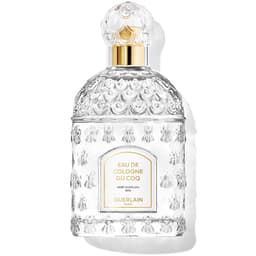
Eau de Cologne du Coq: At the far edges of the Guerlain cradle For Aimé Guerlain, it is sometimes difficult to assert one's creativity when inheriting an olfactory heritage as significant as that of the creator of Eau de Cologne Impériale.
Eau de Cologne du Coq was born in 1984 and resembles a soft, delicate spring water. Both fresh and elegant, Eau de Cologne du Coq is a citrus water, yet it aims to be very invigorating. As delicate as it is, Eau de Cologne du Coq nonetheless displays an animalic, even wild side. Light as a breeze, Guerlain defines Eau de Cologne du Coq as a citrus and very fresh water. It is contained in the legendary “Abeilles” bottle, created by the glassmaker Pochet & Courval in 1853.
Aimé Guerlain, at the helm of Eau de Cologne du Coq
It was Aimé Guerlain (1834-1910), second generation perfumer of the house of Guerlain, who created Eau de Cologne du Coq, in tribute to the actor who played Cyrano de Bergerac, namely Benoit Constant Coquelin (1841-1909). Aimé Guerlain thus succeeded his father, Pierre-François-Pascal Guerlain, the founder of the brand. It can be said that Aimé Guerlain is the one who brought a breath of modernity to the brand. He entered history with Jicky, which completely broke with the codes of perfumery, and was the first to incorporate synthetic components. Aimé Guerlain is regarded as an innovator, a daring figure, a disconcerting perfumer. Aimé Guerlain was the link between the 19th and 20th centuries and left a considerable mark on the house of Guerlain.
Eau de Cologne du Coq, an aromatic citrus water
Aimé Guerlain chose to open his composition with a burst of citrus notes: lemon, orange and bergamot. Mainly grown in the province of Reggio Calabria (Italy), bergamot is an ancient citrus fruit. Although it resembles lemon, it is nonetheless much larger. Bergamot is not a fruit that is eaten; it is used to produce essential oil. Bergamot owes its success, in fact, to its olfactory characteristics. Bergamot essence is obtained by cold expression of the fruit peels. In Eaux de Cologne, bergamot offers a very pronounced freshness, but also soft, floral tonalities. The heart of Eau de Cologne du Coq is composed of patchouli, lavender, rosemary and jasmine, giving off tonalities that are floral, aromatic and sensual all at once. Native to the western Mediterranean basin, lavender was used by the Romans to scent baths and preserve linen. In the 16th century, lavender was used to heal wounds; in the 18th century, lavender was used to ward off the plague. It was not until the 19th century that lavender was cultivated for perfumery. Lavender essence is obtained by steam distillation of the flowers. In perfumery, lavender gives off floral, herbaceous, balsamic and woody tonalities. Finally, the base of Eau de Cologne du Coq combines sandalwood and oakmoss, giving the composition a notable woody character.
A dazzling citrus water, invigorating and original, contained in Guerlain's legendary “Abeilles” bottle. Eau de Cologne du Coq is a marvelous success signed by Aimé Guerlain.