
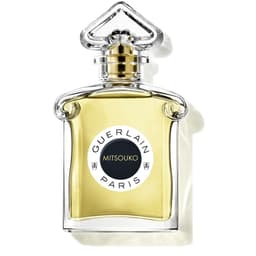
Mitsouko was born in 1919 at Guerlain, composed by Jacques Guerlain, who took its name from the heroine of La Bataille, a novel by Claude Farrère. A fruity chypre, it pairs a synthetic peach with jasmine and May rose over a base of moss, patchouli, vetiver and spices. Thierry Wasser reworked it in 2013; the eau de parfum is sold in the 1912 “inverted heart” bottle.
What the house declares
The house announces a fruity peach accompanied by jasmine and May rose, over a base where spices answer woodland accents and vetiver. It claims balance and originality for the whole.
Guerlain says its own perfumers created the peach accord to render a velvety fruit. According to the house, patchouli, green, woody and earthy, combines with rose, moss and bergamot to form the base of the chypre accord.
A laboratory peach
Peach cannot be distilled. Elena Vosnaki and Ida Meister attribute the peach-skin effect to gamma-undecalactone, known as aldehyde C14, present in the Persicol base, a ready-made preparation sold to perfumers.
Vosnaki describes a peach framed by moss and bergamot, which together form the chypre accord, with accents recalling cinnamon and clove. Victoria Frolova adds an accord of tonka bean, vanilla, iris and rose, the Guerlinade, which rounds out the composition.
Three tiers
The house does not break its fragrance down into tiers. Vosnaki perceives the peach in the heart, with the flowers; Persolaise has the fragrance start from bergamot and descend toward woods and mosses; the house, for its part, places spices, woodland notes and vetiver in the base.
Hence the breakdown used here: bergamot in the top; peach, jasmine and rose in the heart; tree moss, patchouli, vetiver and spices in the base. The moss retained is the one the label declares, tree moss extract, not oakmoss.
Successive formulas
In 2011, Vosnaki listed lemon, mandarin and neroli with the bergamot; clove, ylang-ylang and cinnamon with the peach and rose; labdanum and benzoin with the moss, patchouli and vetiver.
According to Ida Meister, Thierry Wasser restored brightness to the citrus top notes and rebuilt the moss with an accord of his own. Persolaise mentions, among the reported methods, a higher dose of vetiver and an accord imitating oakmoss, to offset the shortcomings of synthetic substitutes.
Victoria Frolova distinguishes the three concentrations of the 2013 version: the eau de toilette has a bright citrus accent, the eau de parfum is all about golden peaches, and the extrait emphasizes a dark jasmine. All three remain, in her view, baroque and rich.
What the label declares
The list Guerlain publishes for the eau de parfum declares tree moss extract (Evernia furfuracea), not oakmoss extract. It also shows eugenol, the main constituent of clove oil, isoeugenol and cinnamyl alcohol.
It also includes constituents of flowers and citrus, such as limonene, linalool, citral, geraniol, citronellol or hydroxycitronellal, as well as alpha-isomethyl ionone, hexyl cinnamal, benzyl benzoate and benzyl salicylate.
Dipropylene glycol and a hydrogenated castor oil help dissolve the fragrance. Three colorants, a yellow, a red and a violet, tint the juice. The house states that the list may change and refers to the packaging.
Similar perfumes
Similar notes and family, from other houses.
- Aromatics Elixir PremierClinique
- Cœur BattantLouis Vuitton
- La Panthère EtincelanteCartier
- L'Air du Temps L'AuroreNina Ricci
- Oud Wa MiskBerdoues
- Gucci RushGucci
- KnowingEstée Lauder
- La Panthère ParfumCartier