
Woody fragrances are generally well liked in fall or winter. Indeed, these are warm compositions built, as their name indicates, around wood.
In 1921, Habanita revolutionized the world of perfumery. It can be said that it is thanks to it that the house Molinard, though existing since 1849, became known to the general public. The house Molinard itself defines its fragrance as an icon of perfumery, with a raw, exposed sensibility... Because Habanita is endowed with a considerable musky spirit, some claim that it is the first oriental fragrance, whereas that “title” is granted to the legendary Shalimar by Guerlain. Be that as it may, Habanita is an ultra sensual feminine essence full of charm and character.
Henri Bénard signs the house Molinard’s first masterpiece with Habanita
In 1921, the fashion in fragrance leaned rather toward eaux de Cologne and soliflore compositions built around a single flower, generally the rose, jasmine or mimosa. Henri Bénard (1874-1939) is the second perfumer of the house Molinard and succeeded Albert Sittler. A renowned French physicist, and mayor of Grasse, Henri Bénard is behind the observation of the “Bénard cells.” In the 1920s, certain fashion houses would dare to take great risks, notably Guerlain with Shalimar (1925) or Chanel with the legendary N° 5 (1925). Avant-garde at heart, Henri Bénard was about to cause a genuine upheaval in the world of perfumery. Indeed, for the first time, a perfumer dared to use vetiver in a feminine fragrance. At that time, vetiver was a raw material used essentially in masculine perfumery. Moreover, it was paired with patchouli and sandalwood, thereby creating an unprecedented oriental accord! In 1925, Henri Bénard pursued his innovation by creating Le Concreta, the first solid perfume, made from natural flower wax.
Vetiver, the star of the Habanita fragrance
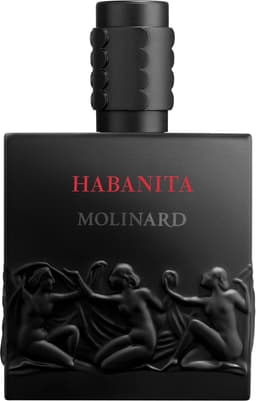
One thing is certain, Habanita is a fragrance of character that stands out and asserts its status. Habanita presents itself right away as the fragrance of glamorous, strong women who love to seduce and smoke without worrying about public opinion. Between power, softness, and sensuality, the balance of Habanita is perfect. Célia Lerouge-Bénard, currently at the head of the house Molinard, states that it has endured through the years, that bringing it to light, illuminating it, and renewing it is both a duty and a source of pride, and that it is a challenge to introduce new generations to such a complex and accomplished fragrance: this eau invites them to make a heritage, a history, their own — a woman’s secret to be lived. Habanita opens on the citrus freshness of lemon combined with that of bergamot. Then, its heart evolves toward floral and feminine tonalities, namely those of rose, jasmine and orange blossom. Finally, the base is steeped in vetiver. The latter combines with patchouli, sandalwood and oakmoss, giving the whole an unprecedented woody oriental accord. In 2012, Célia Lerouge-Bénard brought Habanita back into the spotlight by giving it a new bottle. Both chic and modern, it is dressed in glossy black. The frieze designed at the time by Lalique remains unchanged, echoing the Roaring Twenties of perfumery...