
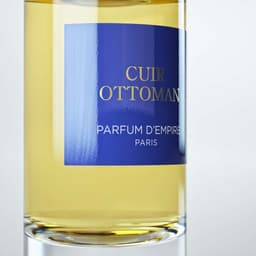
The Ottoman perfume by Parfum d'Empire Leather is by far one of the most sensual raw materials in the world. Almost erotic, it is at once warm and animalic. It is in this spirit of seduction that Marc-Antoine Corticchiato, creator and perfumer of the house Parfum d'Empire, decided to turn it into a perfume.
Released in 2006, Cuir Ottoman reflects the magic and mystery of the Orient. Cuir Ottoman presents itself as a journey to the heart of a starry night, a journey, of course, filled with dreams. Cuir Ottoman also showcases the finest ingredients of niche perfumery, the most noble ones such as leather, but also iris or jasmine. Like most Parfum d'Empire perfumes, Cuir Ottoman takes us on a most incredible and particularly moving olfactory journey. This tribute to the Ottoman Empire is signed by Marc-Antoine Corticchiato.
Cuir Ottoman, the Orient, Marc-Antoine Corticchiato's version for Parfum d'Empire
Born in Morocco in 1960, Marc-Antoine Corticchiato grew up amid the wonderful scents of the Mediterranean. He nevertheless traveled very often to Corsica, to the family property. Passionate about horseback riding, Marc-Antoine Corticchiato was headed for a career in equestrianism. Fascinated by plants, he undertook studies in botany, chemistry, and biology. Marc-Antoine Corticchiato then managed to gain admission to the prestigious ISIPCA school. In 2002, Marc-Antoine Corticchiato created the company Parfum d'Empire with the aim of restoring the original meaning of perfume, namely the sacred and the erotic. His first perfume, Eau de Gloire, was released in 2003, and pays tribute to his father, who had a particular fondness for Napoleon Bonaparte. In the world of perfumery, Marc-Antoine Corticchiato is considered atypical and original. He runs his company from A to Z, and creates his perfumes himself. Marc-Antoine Corticchiato is responsible for magnificent fragrances such as Le Cri de Lumière, Tabac Tabou, and also Yuzu Fou.
Cuir Ottoman, the olfactory tribute to the Ottoman Empire
The saga of the Ottoman Empire began in the 14th century, and reached its peak in the 16th and 17th centuries under the reign of Suleiman the Magnificent. With Constantinople as its capital, the Ottoman Empire stood at the center of interactions between East and West. Here, it is this entire duality and this strength that Marc-Antoine Corticchiato has captured in his fragrance. Cuir Ottoman opens with very floral, powdery notes thanks to the presence of iris and jasmine. Then its heart develops toward a dazzling leather accord, composed of labdanum cistus, styrax, birch, Tolu balsam and benzoin, forming a particularly powerful oriental composition. Leather is a truly natural product. Our ancestors used hides to protect their bodies, hands, and feet. Leather is made from the skin of any mammal, bird, fish or reptile, through a process called tanning. The earliest leathers came from cows and pigs. The first treated hides date back to 17,000 BC. At that time, flint and shells were used to treat leather. In perfumery, leather accords are very old. It was mainly Cuir de Russie by Chanel, released in 1927, that put leather in the spotlight. Leathery notes are obtained by combining synthetic and natural raw materials. Leather gives off notes that are soft, spicy, powerful, sensual or even tarry. Finally, the base of Cuir Ottoman is luminous and deep, combining vanilla, incense and tonka bean, for a most captivating result.